Contents
- Way #1: Students Do the Cognitive Work Instead of Watching It
- Way #2: The Story Carries the Argument, Not the Scoreboard
- Way #3: It Solves the Motivation Half Curriculum Cannot
- Way #4: It Forces Retrieval Instead of Replay
- Way #5: It Adjusts Difficulty to the Student
- Making Educational Entertainment Worth the Class Time
Most of what gets sold as educational entertainment is a coat of paint on an unchanged lesson. And the gap between the paint and the real thing is clear and measurable. In this article, we’re walking through the five mechanisms genuine educational entertainment can carry into a lesson, and how to split the quality version from the window-dressed one. Both look fun from the back of the room, but only one earns its place in the classroom.
Educational entertainment is any lesson that borrows the machinery of games, stories, or video to teach something the curriculum already wanted taught.
It’s a broad definition for a broad category.
The escape-room review lesson belongs to it. So does the video game math app with the badge dashboard. The animated explainer. The class novel. The simulation.
All of it gets filed under one heading and defended with one sentence: the students loved it.
Nobody disputes that.
A room of eleven-year-olds will love a leaderboard or a movie lesson. But they’ll love it whether or not anything fundamental changed.
But here’s the harder question: Did the fun do the teaching? Or did it sit next to it, keeping everyone excited while the teaching happened somewhere or sometime else?
Strip the noise and entertainment can carry exactly five mechanisms into your classroom. Anything in front of you either runs one of them or wears it as a costume.
And the difference WILL show up months later, in what your students can do when you’re not around to help.
Here are five ways genuine educational entertainment can boost real learning.
Way #1: Students Do the Cognitive Work Instead of Watching It
Two lessons. Both loud, both popular, both fun.
In the first, the lesson runs exactly as it always does. You’ve attached a scoring system to the outside, and you get a badge for finishing, but it’s still pushing the same group worksheet you’d run individually in a standard lesson.
In the second, the educational game is the lesson. A student makes a decision, the system responds, the decision turns out to be wrong, and they work out why before trying again. In this version, the activity is the act of thinking.
From the back of the room, those lessons can appear to run awfully similar. We’re here to tell you the student learning experiences are fundamentally different.
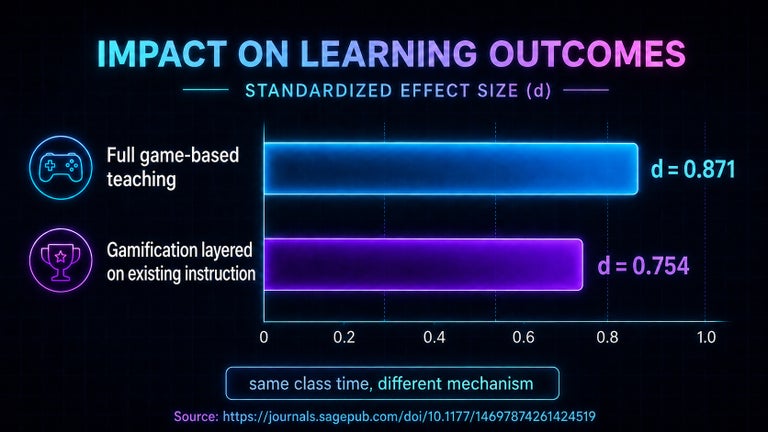
Across 193 randomized and quasi-randomized trials producing 1,029 separate effect sizes, full game-based teaching returns a 0.871 effect size on learning outcomes. Points-and-badges gamification returns 0.754.
Make no mistake, both of those are large.
We’re not here to bin points-and-badges, and the numbers attached to them are NOT a story of failure.
But it is the story of a smaller win, bought at the same cost in class time. The distance between the two is what you pay for a watered-down version of the fully built deal.
And the reason that gap exists isn’t mysterious.
Surface-level gamification leaves the cognitive work exactly where it was, which for most lessons means with the teacher at the front. Full game-based teaching moves that work onto the student and makes the consequences immediate.
One of those changes what a child’s brain does for forty minutes. The other changes how they feel about doing it.
It’s a subtle but very real difference.
So ask it out loud, about the game plan sitting on your desk: Is the student building around a real-world project, or receiving something with sound effects?
Then run the test in the room.
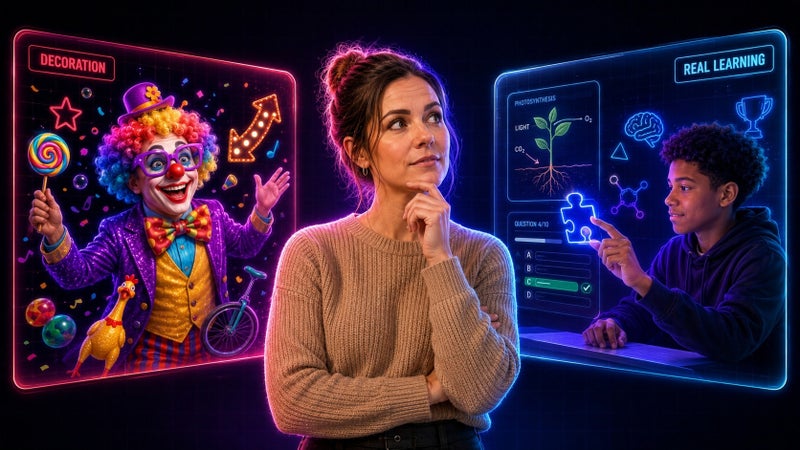
Take the fun layer off the lesson. If a complete lesson is still standing underneath, the entertainment was decoration. If nothing is left standing, the entertainment was the mechanism for delivery.
The second is the type of educational entertainment you should be building for.
Way #2: The Story Carries the Argument, Not the Scoreboard
A story with no points, no levels and no leaderboard still changes people.
That needs saying because entertaining and ‘gamified’ have collapsed into the same word in most staffrooms. Problem is, they’re two different tools doing two different jobs.
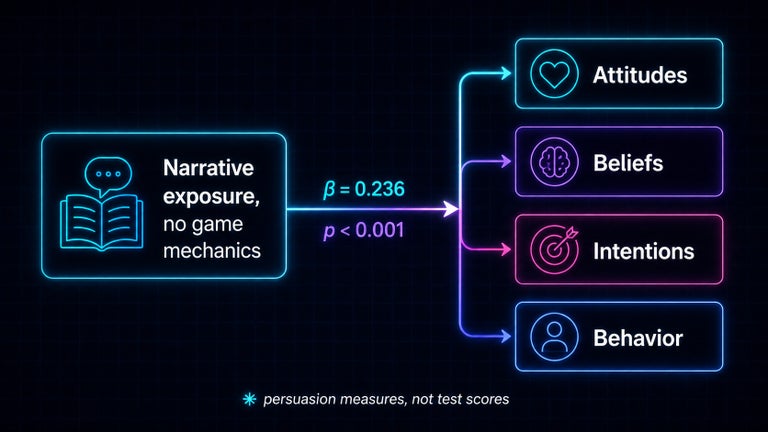
Pooling 77 experimental comparisons drawn from 57 studies, narrative entertainment shifts what people believe and what they do at a pooled β = 0.236, p < 0.001. No game mechanics attached to any of it.
Now read that figure for what it is: persuasion research, not achievement data.
What moved was attitudes, beliefs, intentions, and behavior. Nobody in that body of work sat the students down afterwards and marked a test.
Every teacher has a set of learning opportunities and outcomes that are not based on hard facts. Whether a student thinks a historical decision was defensible. Whether they take a health warning seriously. Whether they’ll argue a position in front of thirty peers instead of agreeing with the loudest one.
Those are stances and choices. And stances and choices are exactly what narrative moves.
A slide deck about the water cycle with a talking raindrop in the corner is not doing this. The raindrop is a spokesperson.
Narrative means the argument lives inside the events, so that following what happened IS following the reasoning.
The read in the room is quick. Ask a student to retell the point without naming the character.
If the point survives intact, the story was carrying it. If all they can give you is the character, all you did was buy a mascot.
Way #3: It Solves the Motivation Half Curriculum Cannot
Curriculum design controls what gets taught, and in what order. It controls nothing about whether a high school opens the book.
That second half isn’t a soft variable you hope for on a good day. It’s a thing you can build. And entertainment is one of the few instruments a teacher has that builds it directly, rather than by asking nicely.
The objection arrives immediately, and every teacher has been trained to make it. Extrinsic rewards kill intrinsic motivation. A points system is just bribery with better PR.
The research underneath that objection is real. But the conclusion drawn from it has been stretched far past what it says.
So, let’s ask someone who builds these systems for a living.
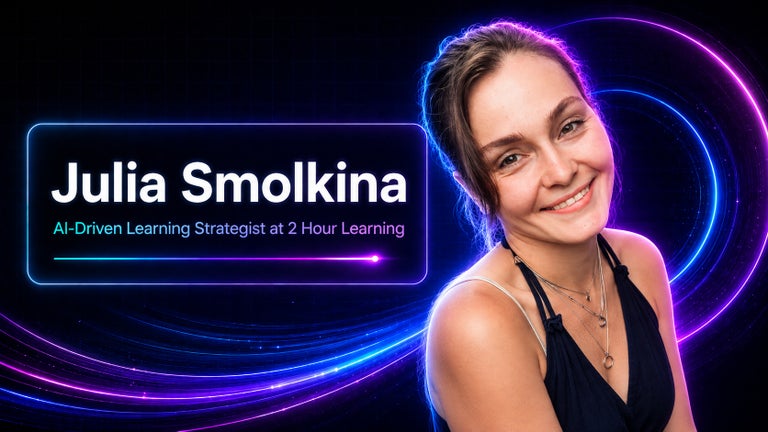
Julia Smolkina - AI-Driven Learning Strategist at 2 Hour Learning - builds reward structures into AI-driven writing work with students. Here’s the question she poses:
“We use XP points - the harder the task, the more points you earn. It’s external motivation, sure, but combined with internal drive from personalized content?”
Julia’s question hints at an answer the ‘bribery‘ objection never gets to.
A reward paid out for effort on genuinely hard work sends a student somewhere they wouldn’t have walked on their own. What happens after they arrive is the intrinsic mechanism.
Finishing something difficult rewires identity around the effort, and a student starts to think of themselves as the “kind of person who does hard things”.
The points bought the first attempt. The attempt bought the belief. The belief is what’s still running when the points stop.
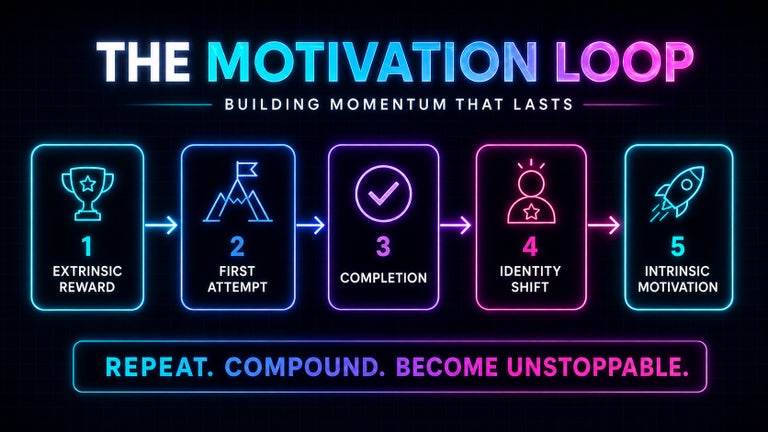
Which is also the test that separates a motivation mechanism from a motivation costume. And it turns on what you pay for.
Reward the difficulty and the effort, and the scaffolding hands control back to the student on its way out.
Reward speed, compliance, or attendance, and you’ve paid full price for behavior that was going to happen anyway, while teaching the room that the work is only worth doing while somebody’s counting.
Two entirely different things.
Way #4: It Forces Retrieval Instead of Replay
Watching something brilliant twice is still watching. Memory is built by pulling information out of a head, not by pushing more into it.
That single fact is where most educational entertainment falls over. Because the dominant format in the category is video, and video asks a student for nothing except attention.
Re-watching feels like studying - yielding the warm sense of recognition that studying produces. But it builds almost none of the recall.
This is also where the honest limit sits.
A randomized trial back in 2025 ran 210 students through either edutainment video-based learning or ordinary classroom instruction, then followed them for six months. On behavior change, the video format held its ground - yielding improvements of 1.19% to 28.13%, against 1.90% to 15.16% for the classroom.
But on core knowledge transfer, the classroom won.
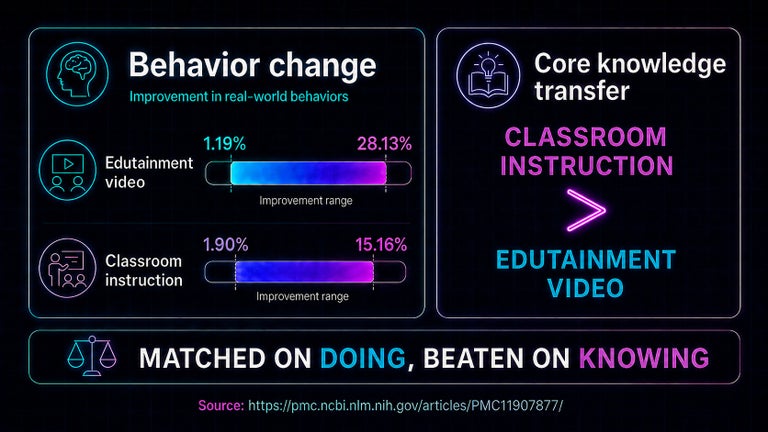
The split result is the argument.
A video changes what students do without ever asking them to produce what they know. So it moves behavior, and leaves knowledge to the format that makes students answer things.
Entertainment that forces retrieval is a different animal entirely, and one of the few learning tools that can make recall feel like part of the action.
The escape room where the lock will not open until somebody recalls and problem solves around last week’s formula. The quiz show where the buzzer is useless without the answer already in your head. The game whose next level is gated behind content from three lessons ago.
In every one of those, the fun is structurally impossible without the recall. That’s what makes the fun load-bearing.
So count it, over a single lesson. How many times did each student produce something out of their own memory, and how many times did they receive something well made?
A high second number and a low first is a lesson that will feel excellent on Friday and be gone by half term.
Way #5: It Adjusts Difficulty to the Student
An activity pitched at the wrong level entertains beautifully and teaches nothing.
Too easy, and a student wins without thinking. Too hard, and they hand the controller to whoever’s sitting next to them and become an audience for their own lesson.
Neither child is having a bad time. Neither child is learning.
And the prize for getting this right is a BIG one.
One-to-one mastery tutoring, paired with personalized learning, lifts the average student above 98% of peers taught in a conventional classroom.
An AI tutor does two things a teacher with thirty children structurally can’t: adjust the difficulty on every single question, and keep one learner motivated through the adjustment.
When it works, the game gets harder the moment a student stops struggling, and easier the moment they stall. Per child. Per question. Without a teacher having to notice.
That’s a genuine mechanism, and it’s one thing software does better than a human in a room of thirty.
Here’s the key: watch the ends of your room, not the middle. Who finished early and stayed cheerful? Who spent the lesson looking busy?
If the activity never moved for either of them, it entertained thirty children but only taught the eight in the middle.
Making Educational Entertainment Worth the Class Time
Educational entertainment earns its place in a timetable when it does the delivering, not the decorating.
You now have five filters for any of the ‘fun lessons’ sitting in your planning folder. Here’s the test framework to separate real educational entertainment from the fake kind:
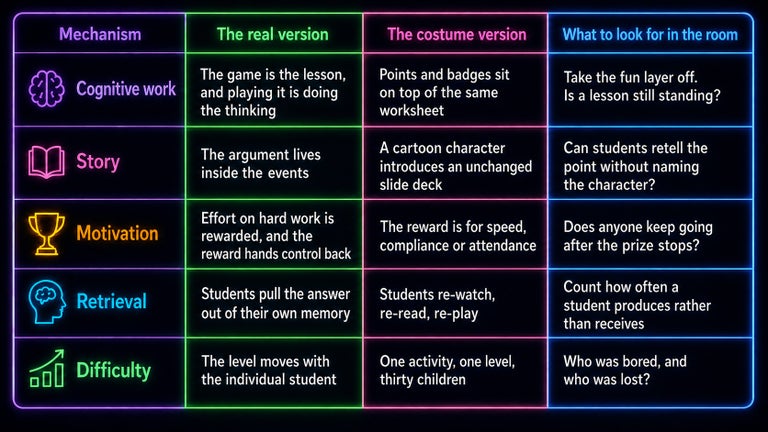
An activity that runs one of those mechanisms is doing work no worksheet can do. An activity that runs none of them is a pleasant forty minutes you can’t get back.
The loud lesson and the good lesson can look terrifyingly similar to the untrained eye. They stop looking identical the moment you ask which one would collapse if you took the fun away.
Ask the right questions, and boost your lesson with the real version of education entertainment.
Want to build the AI era of education? Apply now through Crossover.
Similar post


Want to read more?
We have a lot more where that came from


 AI-first education leaders.