Contents
- Kahoot!: The Whole Class Answers at Once
- Gimkit: Correct Answers Buy the Upgrades
- Prodigy Math: Quests That Reroute When a Student Stalls
- Wayground: One Question Bank, Game or Exam
- Minecraft Education: Students Build Instead of Answer
- Where a Gamified Learning Platform Earns Its Class Time
Most of what gets sold as a gamified learning platform in 2026 is decoration bolted onto a lesson that never changed. The mechanic either carries the academic work or sits beside it - and that difference is a a BIG deal for student outcomes. From full-class participation to voluntary repetition, we’re backing five platforms for US K–12 classrooms based on what each one makes a student DO.
Contrary to popular belief, the case for a gamified learning platform does not rest on the atmosphere in your classroom.
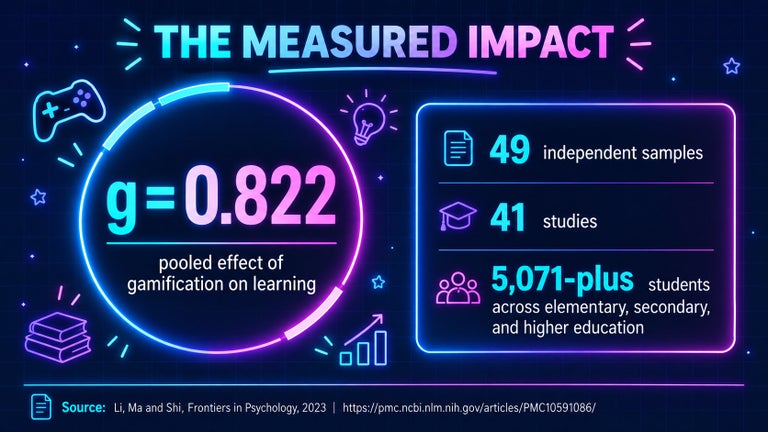
Across 41 studies in educational settings, the measured effect of true gamification on learning came back at a Hedges’ g of 0.822. In education research, that is considered a large effect.
Most people approach gamification as a superficial layer: a way to put smiles on faces and energy in the room. That matters, but it leaves too much on the table to justify giving a platform anything more than a Friday fun-day.
Because - when deployed correctly - the right gamified learning platform might just be one of the most important tools for helping kids hit their limitless potential.
Game mechanics are the pedagogical decision worth talking about.
So, here is the question to ask: is the mechanic running on the academic work, or is it just running alongside it?
A badge screwed to the outside of a passive worksheet runs alongside the work. The lesson underneath is untouched, the reward gets paid out for finishing rather than thinking, and the day the badges stop, the behavior stops with them.
A mechanic that runs on the work pays out for the work. Answer more questions, get more game. Make the build stand up, and it stands up. There is no separate lesson hiding underneath, because the lesson is the game design.
That difference is the whole of it.
It decides whether forty minutes of noise bought you a term’s worth of practice, or a term’s worth of nothing.
Here are five gamified learning platforms built for US K–12 classrooms, and the mechanic that earns each one its place.
Kahoot!: The Whole Class Answers at Once
💵 Pricing (USD): Try for free; paid school plans up to $19 a month
Run a review lesson on raised hands, and you already know who’s doing the work.
It’s four students. The same four, every time, while the rest of the room learns that thinking is optional as long as somebody faster is sitting nearby.
Kahoot! closes that route. A question goes up for the whole room, and every student has to actively participate by committing to an answer inside the same timer, in the same moment. There’s no version of the round in which a student can simply wait it out.
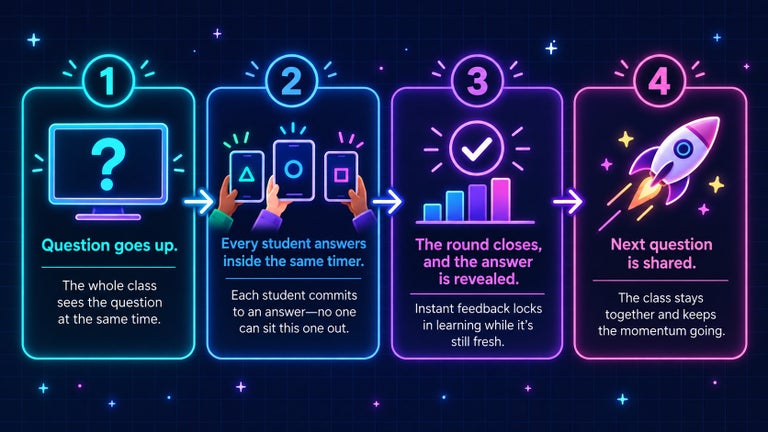
What elevates Kahoot! above basic gamified noise is the act of committing to an answer.
Doing the mental work to pull a fact out of your head and put it on the record constitutes retrieval. And retrieval is the ultimate mechanism for building and testing durable memory.
A raise-your-hand round produces one retrieval per question. Kahoot! produces one per student, per question.
Same forty minutes. A radically different volume of thinking.
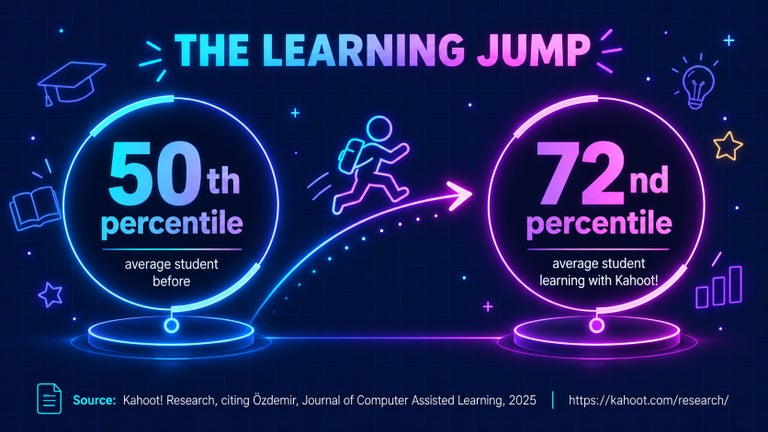
And that volume shows up in the research. Pooling 43 independent studies involving more than 3,000 students, a 2025 meta-analysis in the Journal of Computer Assisted Learning put the average Kahoot! student’s learning outcomes at the 72nd percentile - 22 points above the control. That’s a FULL letter grade of movement just from getting every kid in your class to hazard an attempt.
Gimkit: Correct Answers Buy the Upgrades
💵 Pricing (USD): Free basic version for educators; Pro plans at $59.88 a year
Most question sets get one serious pass.
A student works through a 20-item sheet, hands it in, gets a grade, and maybe - maybe - sees those questions again during test prep. That’s a huge waste, because the second, third, and fourth rounds of repetition are where much of the learning was hiding.
Gimkit approaches the repetition problem by paying students to keep answering. Every correct answer earns in-game currency, which buys upgrades that change how the next round runs.
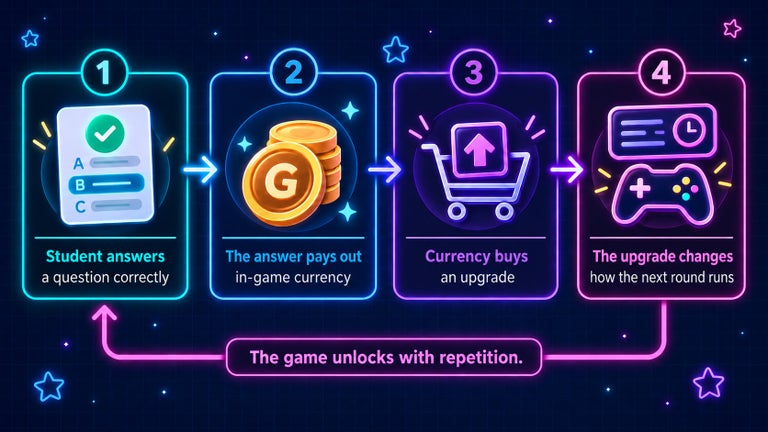
Here’s what that incentive does to the repetition equation.
The reward for answering a question is a better position from which to answer more questions. A student who wants to win gets a leg up when they buy the expensive upgrade. That expensive upgrade can only be earned through more hard sets and reps.
Repetition stops being something you have to enforce and becomes the thing the student willingly chases.
Students will work through the same 20 items five times because every pass buys them something new. And by the time they hit the fifth pass, they’re inadvertently earning considerably more than the baseline worksheet could ever offer.
This is a gamified learning platform where healthy competition and incentives drive hard work.
Prodigy Math: Quests That Reroute When a Student Stalls
💵 Pricing (USD): Free for teachers; $58.95 annually for Math Core membership
The child who stalls halfway through a unit is the hardest problem in a class of 30.
You know what’s happening. But you also know that rerouting that student - back through the prerequisite skill they never locked down - means stepping away from 29 others.
Prodigy Math places math questions inside a role-playing game. Students move through a world, take on quests and win battles by answering the question in front of them.
Sounds ordinary enough…
What’s not ordinary is what happens when a student gets something wrong.
Prodigy leans on an individualized learning path that pushes way past what most gamified learning platforms offer. Get an answer wrong, and the platform drops you down to the prerequisite skill that question depends on. You work through it, get back up to pace, and keep moving forward - gaps filled.
The reason that lands for the individual and their learning experience is the narrative it runs on. The difficulty moves while the quest keeps rolling, creating a sense that the reroute is just another step in the game - not a grade demotion.
There’s no public moment where a student becomes the one who needed extra help.
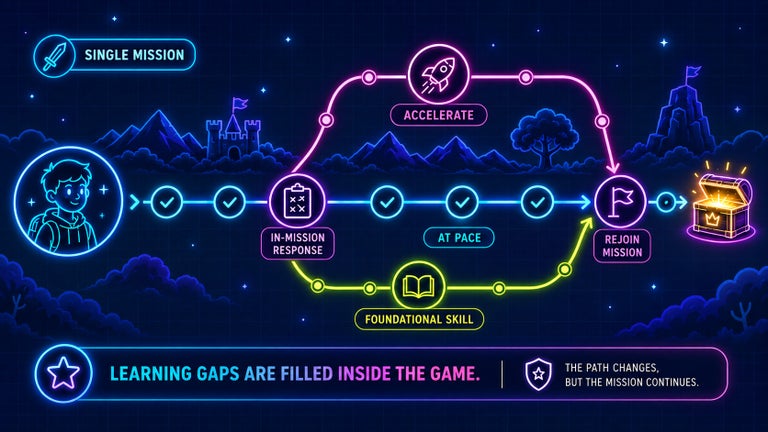
And it’s clearly a mechanism with bite. New numbers coming from Prodigy’s newsroom put its reach at 4.2 million students across 70,000 US schools.
This is the difference between a kid barely keeping up (and being embarrassed for it), and a kid cheerfully filling gaps because the mission gave them the individualized instruction they needed to get better.
Wayground: One Question Bank, Game or Exam
💵 Pricing (USD): Free for teachers; school and district pricing available by quote
Building the same content twice is a tax every teacher pays. Once as something students will want to do, once as something you can grade.
Two builds, one body of material, and an assessment that can never quite cover what the fun version drilled.
Wayground - you might already know them as Quizizz - collapses that work into a single build. One bank of questions runs as a competitive game on Tuesday and a straight assessment on Friday. Same items, same standards, different mode. The switch is a setting, not a complete rebuild.
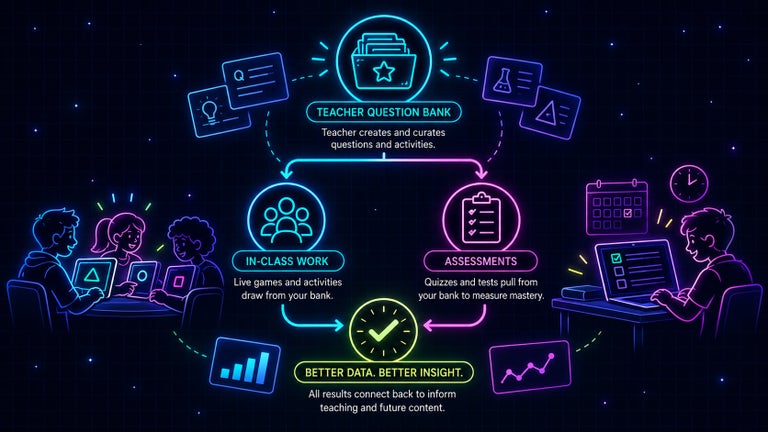
That fixes something more valuable than your prep time. When the game and the test draw from the same bank, Friday’s score measures exactly what Tuesday’s session drilled. There’s no gap between what students practiced and what you’re grading.
A low score tells you something real about the content, not about a mismatch in the delivery.
Wayground says its platform is used by teachers in 90% of US schools and across more than 150 countries. That puts the dual-mode question bank in ordinary classrooms, not just those with generous technology budgets and a spare week for configuration.
This is one prep doing two jobs - and scores that map directly onto the practice that came before them.
Minecraft Education: Students Build Instead of Answer
💵 Pricing (USD): $5.04 per user/year for eligible institutions; $36 per user/year for camps, clubs and other organizations
Some understanding will never be built through raw questions.
Ask a student whether they understand scale, or why a circuit needs a complete path, and you may get an answer assembled from the words you used in your lesson. That’s not nothing, but it’s also not true understanding.
Minecraft Education makes the academic task a build. The student doesn’t answer about the concept. They construct something inside a world that works only if the concept has been applied correctly.
That distinction does real pedagogical work. Recalling a rule and applying it are different operations, and only one of them shows up in what gets made.
Circuits that don’t light up create feedback loops without a teacher having to deliver the feedback. A student who rebuilds it four times to get a result has completed four rounds of applied reasoning and problem solving on a concept they might otherwise have written one sentence about.
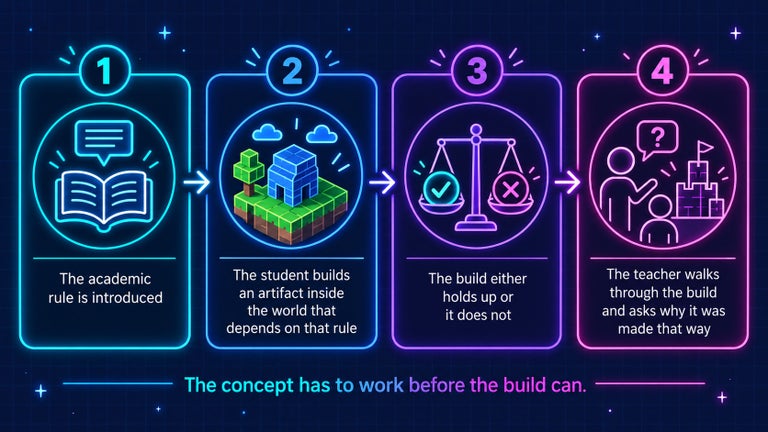
The build also leaves you something to interrogate. It’s a piece of student work you can walk through and ask questions of: Why this way? What happens if we take that block out?
Try running that conversation from a multiple-choice score...
This is the widest reading of what gamified can mean - and the platform where the game and the work are hardest to distinguish.
This is the gamified learning platform where the build is the assignment.
Where a Gamified Learning Platform Earns Its Class Time
A gamified learning platform earns its place in class when its mechanics strengthen the learning environment around it. That gives you a practical test for every platform you consider.
What does a student have to do to move the game forward?
Kahoot! leans on participation by making every student commit to an answer. Gimkit uses repetition by making correct answers the only way to buy more game. Prodigy has individualized instruction that reroutes students through the skills they’re missing. Wayground hits alignment by building practice and assessment from the same question bank. Minecraft Education pushes application by making the concept work before the build can.
Those are the mechanisms to look for if you gamify learning activities: full-class commitment, rewards funded by correct answers, responsive difficulty, continuity between practice and assessment, and tasks where knowledge has to be applied.
Put surface-level gamification features like points, badges, and leaderboards beside the lesson, and you may create movement without moving the learning. Build the game on the right mechanism, and every push for more game produces more academic work.
The platform isn’t there to make a lesson look more appealing. In strong game-based learning, fun is the route through learning.
Looking for a school where kids learn through doing? Our partners are making that a daily reality.
Similar post


Want to read more?
We have a lot more where that came from






 AI-first education leaders.