Contents
- Find Your Career Shape [A Mini Course]
- The Real Meaning of I, T, V, M and X
- Why The Market is Moving Towards X
- How to Build an X-Shaped Career
- Start Where Your X is Missing
Are you an X-shaped professional? Increasingly tech CEOs, leaders and visionaries are calling for them. They’re the people in demand – the ones who have the unique skill stack that can take companies to the next level. And you’re going to be one of them.
Everyone has a career shape based on their skill sets.
In 2027 – X will mark the spot.
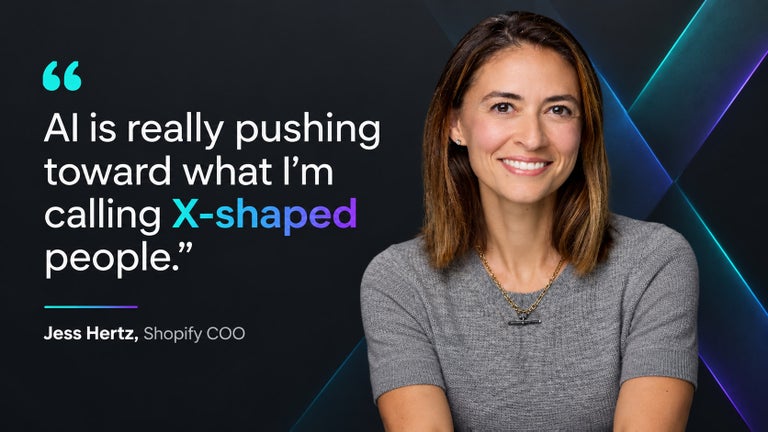
Shopify COO Jess Hertz recently said, “AI is really pushing toward what I’m calling X-shaped people.” She’s watched in real time how T-shaped pros have evolved into this new type of professional – and believes the future of tech is in their hands.
Don’t be alarmed.
These career shapes exist whether you’ve known about them, or not. They’re visual models that are used to describe how your skills, expertise and interests are distributed across different areas of your work. It measures their depth and breadth.
We once walked our careers in a straight line.
But these days with career development on fast forward – these models help you understand if you’re a specialist, more of a generalist or a desirable combination of both – and most critically – how to get to X.
Intentional skill building is all about knowing where to invest your time.
For many years we were told to become T-shaped pros. Build skills in one core specialty, then add enough breadth to collaborate with everyone around it. Great advice! If it was 2022.
Careers have changed – we have I, T, V, M and X shapes now.
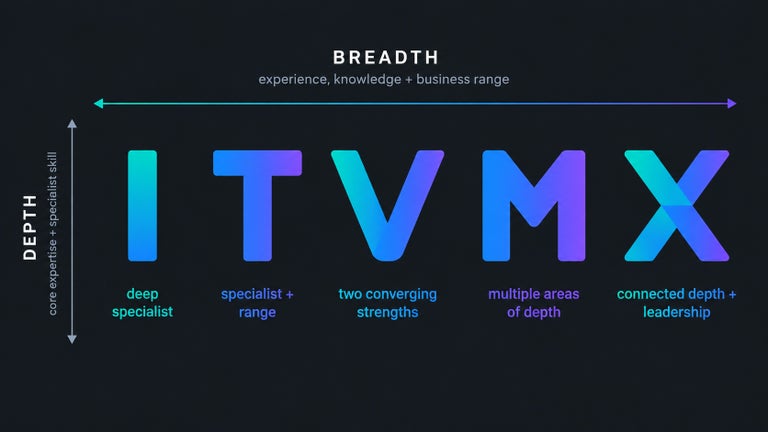
An I for example, digs deep into one core specialization. A T adds breadth. A V develops 2 mighty strengths that converge. An M builds several skill areas with real depth. And an X…well that’s why we’re here.
X-shaped professionals are the most intriguing of all.
They connect those capabilities with judgement, synthesis and leadership - then own the problems that don’t stay put inside a single department. They own ambiguity.
Here’s what’s happening right now in tech:
- According to PwC 2026 Global AI Jobs Barometer – the career ladder has been set on fire. Folks in AI-exposed junior roles are 7X more likely to need senior skills like leadership and strategic thinking.
- The DDI 2025 HR Insights Report says only 20% of CHROs believe they have leaders who are ready to fill seriously important business roles. And 86% of HR respondents are saying the demand for people with leaderships skills is about to blow up over the next 5 years.
- Microsoft Research has chimed in that firm-wide remote work makes collaboration networks MORE siloed and reduces cross-group collaboration by 25% - revealing a growing gap in highly specific social skill sets in tech.
Put plainly, AI has collided with a massive leadership gap – especially remotely – because it demands judgement, cross-functional collaboration, incredibly high levels of skill and strategic thinking.
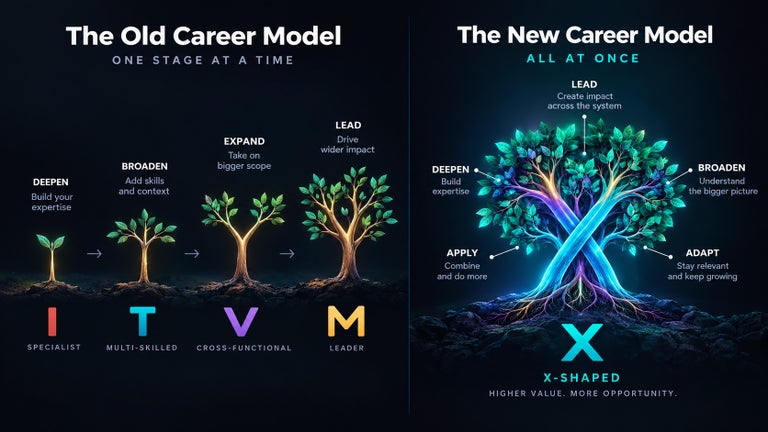
The old career model gave us time. You build your deep, valuable expertise first and THEN you broaden your skills, responsibility, and strategic inputs. Then came leadership. It happened one by one, each had its turn.
AI wants us to build all of this at once. RIP any kind of sequence.
You’re not climbing one wrung at a time anymore – you’re building the whole structure while you stand on it. The modern career asks you to deepen, broaden and lead at the same time.
So, in this article, you’ll identify your current career shape, learn what separates an X-shaped professional from a generalist with an overstuffed résumé, and build a practical route from where you are now to the skills companies will need next.
Find Your Career Shape [A Mini Course]
Go ahead and throw away your job description.
At this point we can all agree – it’s your capabilities and not your job title that matters. With the skills needed for AI-exposed jobs changing twice as fast as those that aren’t as exposed – your path is clear.
You need to understand your current skill stack. You need to know what shape your career is right now, before you start frantically adding skills at random.
So, I built a short course to help you do just that.
It will map your career across the 5 essential career shapes – I, T, V, M and X. It takes a candid, evidence-based look at where you have genuine depth, how far your skills travel beyond your core specialty, and whether you’ve developed in other areas.
And of course – how well you connect those skills through judgement and leadership. It’s a fun career diagnostic and it takes a paltry 5 minutes.
I don’t need you to login or sign up or any of that razzmatazz.
The goal here is for you to get your CURRENT career shape, what it says about the way you create value – and to understand what you should build next.
Building towards X is the 2027 prerogative for high performers in tech.
Learn more skills is trash advice, so is ‘keep up with AI.’
Your mandate isn’t to collect random capabilities, it’s to build the right one next. Take the 5-minute course, and it will put you on the best possible career path.
And hey, share your shape on LinkedIn.
The Real Meaning of I, T, V, M and X
The first thing you need to know about career shapes is that they’re not levels in a corporate video game.
X is not the final level, and I is not a beginner. As I was explaining earlier, they’re not sequential – anyone at any stage in their career (junior or senior) can have any shape.
It comes down to the choices you’ve made about your skill sets, whether consciously or just following a normal (now outdated) career progression. These are a visual model for understanding how your professional capability is distributed.
So:
- Where do you have serious skill depth?
- How much range have you built around that particular skill?
- Do you have MORE than 1 area of core expertise?
- Can you connect these skills when things get complicated?
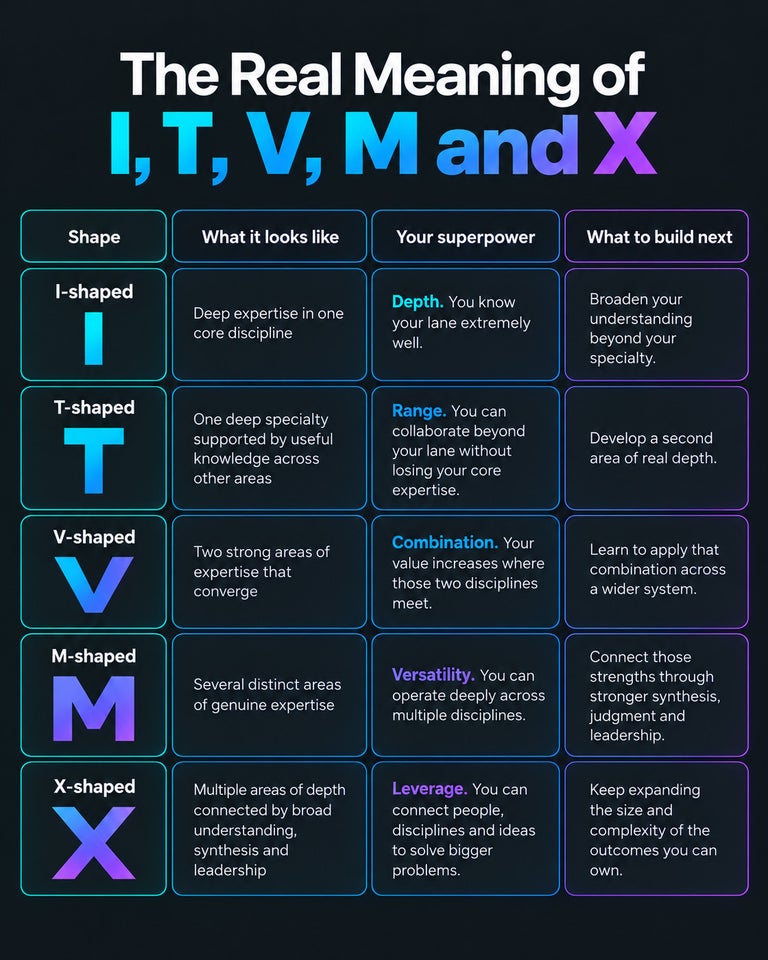
Of all the shapes the biggest change happens between M and X.
A LOT of people in tech are hovering in this area right now. An M-shaped professional has several really valuable areas of expertise. But an X-shaped professional can combine these areas using AI to solve bigger, messier issues.
It means spotting a user issue inside a product problem.
Or connecting technical constraints to commercial priorities. It also means pulling the right specialists together, weighing the trade-offs and making a decision when ownership or outcomes are super unclear.
Defined an X-shaped professional goes deep in more than 1 area, connects those strengths across the business and uses judgement and leadership to own problems that don’t belong to any single function.
They are depth + range + synthesis + judgment + leadership.
M has a lot of strengths, but X uses their strength for company leverage. It doesn’t mean they’re good at everything, it’s the result of building depth and breadth in the right places so that skills start multiplying and complimenting each other.
An X pro is literally a cross-functional specialist who uses AI to extend their impact and connect different parts of the business together – to solve important problems no-one else can own alone.
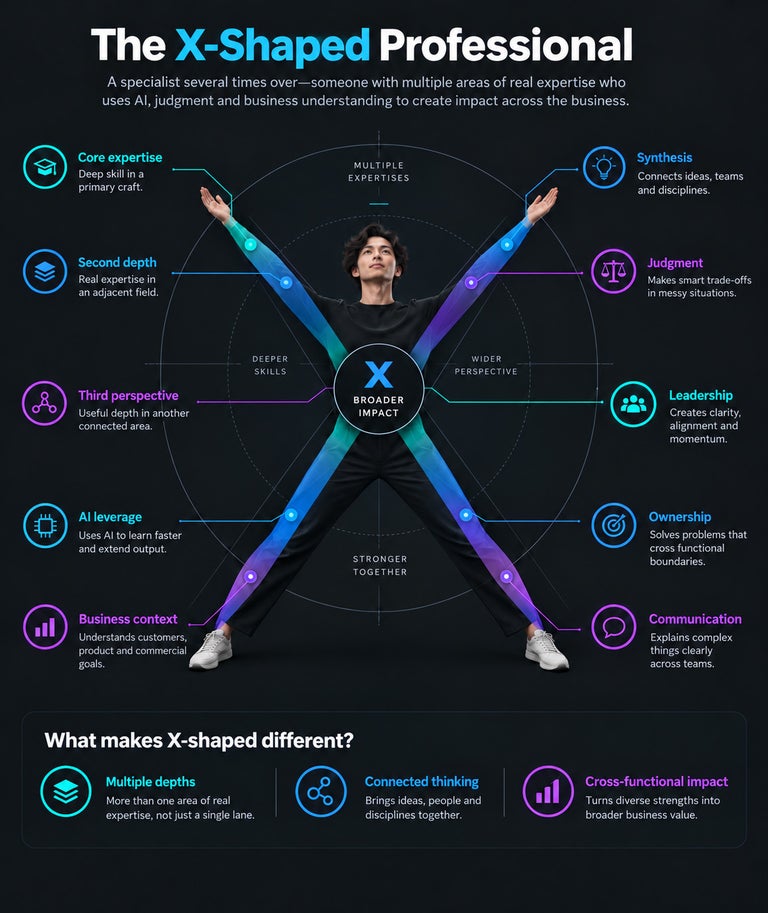
They’re builders – leaders – connectors. They’re end-to-end change agents.
They’re the individuals most likely to harness the full power of AI.
Why The Market is Moving Towards X
We asked our LinkedIn community a simple question:
“Research says AI-Augmented roles now require 36% higher cognitive skills that before AI. Why?”
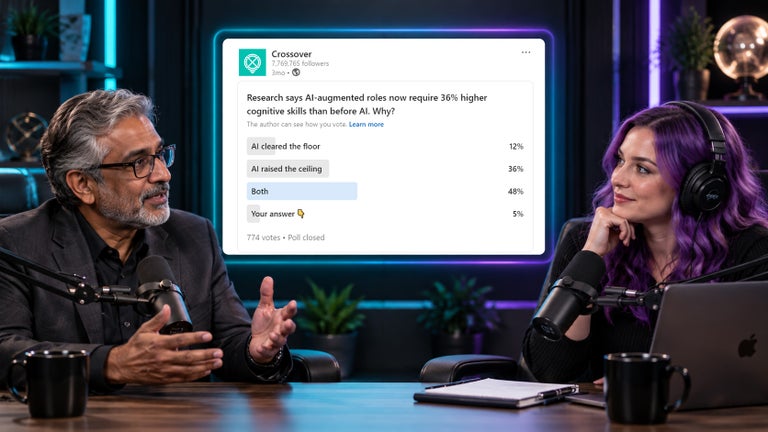
And of 774 respondents – 12% said AI cleared the floor, 36% said it raised the ceiling – but an overwhelming 48% of you said both were responsible.
It’s clear that easier work is disappearing while harder work is arriving earlier on. Funny thing is, the wider labor market echoes these sentiments.
- PwC found that new tasks appearing in AI-heavy jobs are 2.5X more likely to depend on empathy, judgement and creativity. As AI rises, so does the value of social capability.
- The market’s also putting a price on skill combos. An IMF analysis found that job ads requiring 4+ new skills carry a wage premium of 15.1% in the UK and 8.5% in the US. The strongest value combos are technology, engineering, business and data analysis.
- The World Economic Forum places AI and big data, analytical thinking, creative thinking, resilience, curiosity and leadership together among the skills rapidly rising as we head towards 2030. It’s not machine or human – it’s BOTH.
Just look at the current capacity for substitution by Generative AI:
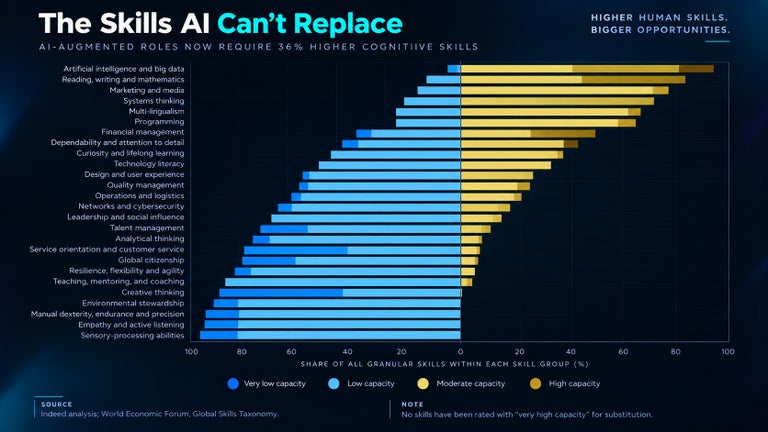
Even LinkedIn expects some 70% of the skills used in most jobs to change by 2030. People entering the workplace today are on track to hold twice as many jobs over their careers – compared with folks entering the market 15 years ago.
All of this change demands a new kind of skill stack.
Employers aren’t writing that they need X-shaped professionals at the top of every job post just yet. But they’re asking for the skills already, and big tech is realizing it.
The label is new but the skills are already in short supply.
Demand is only going to increase.
How to Build an X-Shaped Career
You need that X-factor.
There’s plenty of evidence that proves X-shaped professionals are going to be the GOATS of 2027 and beyond in tech.
They’ll get the best jobs, the biggest pay checks and the most opportunities. Naturally, every high performer will want to become one.
And it’s time you took this seriously because you deserve a fantastic career. Despite the instability, and volatility and extreme circumstances – you can make it work.

But you don’t become an X pro by collecting skills as you go like a Pokémon app.
You need your core skill and then a deliberate, intentional plan to add the capabilities you need – to accelerate your value as a leader.
The WEF says 59% of workers will need training by 2030. The IMF eLibrary gives us another sneak peek into the future – where these skill vacancies are associated with higher wages. As you acquire more skills, you earn more.
So yes, indeed skill stacking still matters. What matters more is the order these days.
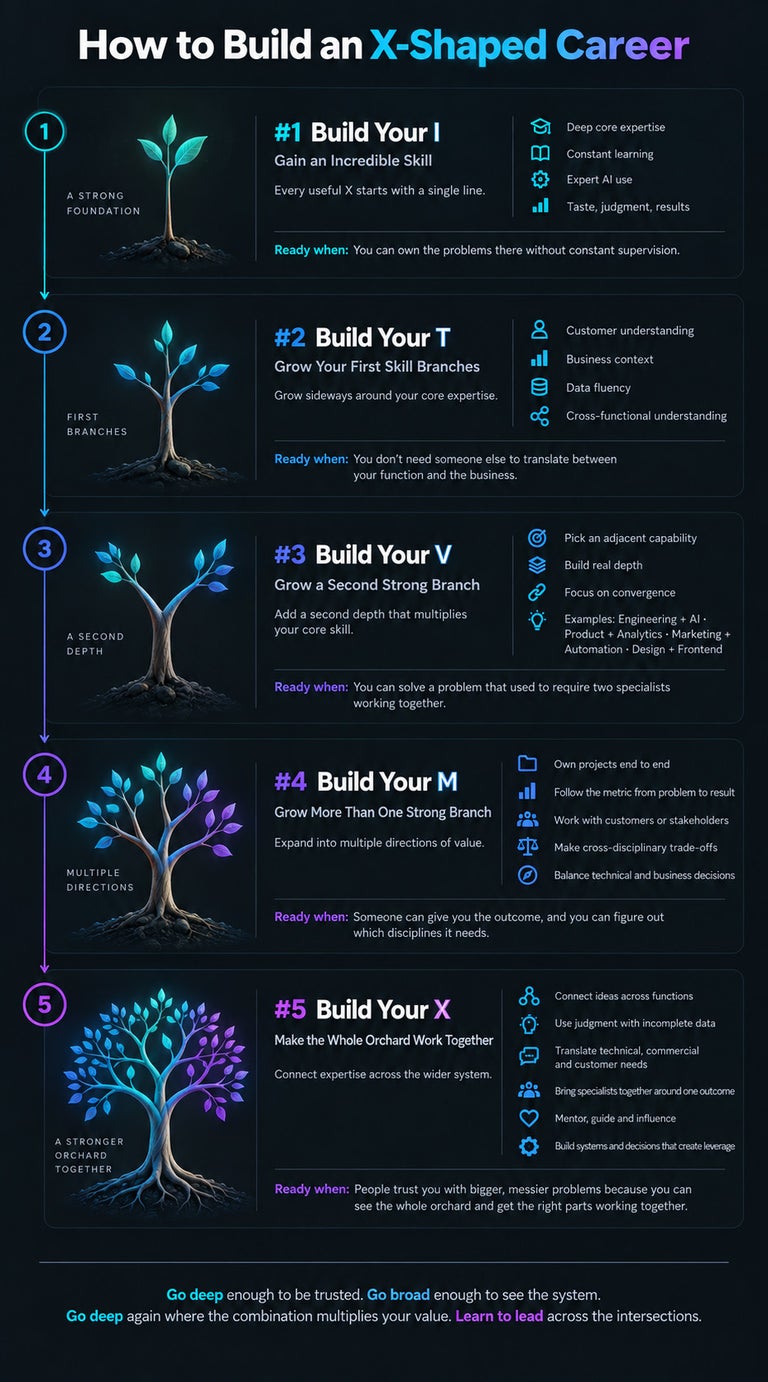
#1: Build Your I: Gain an Incredible Skill
Every useful X starts with a single line.
Pick a skill or specialty and run with it. Go deep. I mean become the person other people go to when they need to understand what’s going on in that area. This will be your core expertise – the trunk upon which all other skills should branch from.
- Constant learning in that area (stay up to date)
- Expert AI use (you know when AI is wrong in this area)
- You have finely honed taste, judgement, experience and results here
This is the trunk of your skill tree, it has the roots that ground everything else.
You’re ready to move on when you can own the problems there without constant supervision.
#2: Build Your T: Grow Your First Skill Branches
Now that your trunk is strong it’s time to grow sideways.
Your core expertise is more valuable when you understand the system it exists in. It’s the reason why specialists do MBA’s, because business is that reason. Learn how your work impacts your customers, your business, the data and teams all around you.
Your first branches should include:
- Customer understanding: Who you’re working for and what they value
- Business context: How your company makes money and what success looks like
- Data fluency: Enough to interpret the numbers behind your decisions
- Cross-functional understanding: How adjacent teams work, measure success and make trade-offs
This is where your skill tree starts to spread beyond one narrow lane. You’re not just producing your piece of the work and staying ignorant to everything else.
You understand where it connects, who depends on it and what happens next.
You’re ready to move on when you don’t need someone else to translate between your function and the rest of the business.
#3: Build Your V: Grow a Second Strong Branch
Awesome, your skill tree has a solid trunk and some decent reach.
Next up is to add another branch strong enough to carry weight. Breadth helps you understand more, but a second depth lets you DO more.
And with a V-shape, it’s about convergence. Pick an adjacent capability that multiplies your core experience, then go deep enough that it becomes a major strength all on its own.
I’m talking about star pairings:
- Engineering + AI
- Product + analytics
- Marketing + automation
- Design + frontend
- Security + cloud
- Data + commercial strategy
This second branch is FAR from random. It organically connects to your trunk and makes you more useful at the intersection. Suddenly your skill tree becomes so much harder to copy.
You’re ready to move on when you can solve a problem that used to require two specialists working together.
#4: Build Your M: Grow More Than One Strong Branch
Your skill tree needs more than one significant direction of growth.
It’s time to stop thinking in tidy job descriptions and instead take on work that crosses functions, teams and priorities. It’s hard – but it’s exciting!
When you do this your job becomes so much more than just contributing your piece, it becomes your job to understand the WHOLE outcome.
That means:
- Owning projects end to end
- Following the metric from problem to result (and back again)
- Working directly with customers or stakeholders
- Making trade-offs across different disciplines
- Understanding enough commercial context to know when the best technical answer is still the wrong business answer
An M-shaped pro’s goal is to build multiple branches like this that can each carry a ton of weight. This is a real turning point in your career – when your skill tree becomes multidirectional, and where you can prove value from more than one angle.
You’re ready to move on when someone can give you the outcome, and you can figure out which disciplines it needs.
#5: Build Your X: Make the Whole Orchard Work Together
By now, your own skill tree can withstand any natural disaster.
You’ve built your trunk with deep roots, and it has many converging branches.
X is what happens when you stop thinking about your own tree and start to see the orchard as a whole.
You’re able to look across teams, functions, disciplines and understand how the pieces fit snugly together. You know when to bring in another expert sure, when to challenge the obvious answers and when the big problem is hiding somewhere no-one is looking.
That means:
- Connecting ideas and expertise across functions
- Using judgment when the data is incomplete
- Translating between technical, commercial and customer needs
- Bringing specialists together around one outcome
- Mentoring, guiding and influencing without needing formal authority
- Building systems and decisions that create leverage beyond your own work
Leadership has arrived in a big way in X. It’s not your title or org chart that determines this – it’s your ability to create clarity, alignment and authentic movement when the problem is messy as heck and ownership is all over the place.
This is when your skill tree stops being a simple collection of strengths. Or put another way, it stops only producing its own apples.
Instead it becomes a system that helps the entire department, the entire business work better. That’s not just more apples from your tree, that’s more apples from EVERY tree.
Because of you.
You know you’re X-shaped when people trust you with bigger, messier problems because you can see the whole orchard and get the right parts working together.
The progression through career shapes is:
Go deep enough to be trusted. Go broad enough to see the system. Then go deep again where the combination multiplies your value and learn to lead across the intersections.
Start Where Your X is Missing
Most people wouldn’t mind that their X was missing (lol).
Jokes aside, it’s easy to become complacent when turbulent change is the norm. The good news is that your career already has a shape.
You absolutely don’t need to reinvent everything about yourself.
What you do need to do – is take a closer look at the skill tree you’re growing and figure out which branches are missing.
It’s the easiest thing in the world to stay an NPC in your own life. To keep playing the same character and hope beyond hope that things will return to normal, or the game will settle down.
It won’t.
It’s true that your career is making unfair demands on you. It wants you to lead sooner, develop multiple skills faster – and figure out how to master AI like an engineer. None of things are easy, but that’s also what makes success worthwhile.
Love it or hate it, AI is your biggest power-up.

It can help you explore unfamiliar disciplines, practice faster, learn better, prototype ideas and build competence in areas that took decades to master in the past.
But AI can’t choose your build for you.
It doesn’t know which missing branch will multiply everything else you already know. It can’t earn trust, develop good taste or become the person others hand their peculiar, chaotic and high-stakes issues to when no-one knows how else to realize the goal.
Only you can become that person. That’s still your job.
So, stop treating your career like it’s stalled or worse – an endless list of useless upgrades with no end destination.
Know where you are to get to where you’re going.
If you’re already an X-shaped professional, congratulations – you’ve just made it into a tiny, high demand group of people in tech whose careers will skyrocket over the next 5-year cycle. If you’re not there yet, pay attention.
You can’t control how the game changes, but you can control the player you become.
Similar post


Want to read more?
We have a lot more where that came from


 AI-first education leaders.