Contents
- Agentic Workflows and The Rise of Talent Debt
- The Zone of Genius Framework (Using AI to Boost Talent)
- Your Zone of Genius Has to Be Balanced
AI can make you dramatically better at your job. Or it can make you dramatically better at producing work you barely understand. The difference is talent debt - the gap between what your agents can help you deliver and the expertise you’ve built to explain, challenge and reproduce it. So, how do you make sure your talent keeps growing when AI does the boring work?
Your Zone of Genius has a training problem. So does mine.
It’s true, AI can make you look more capable before it makes you more capable. It’s the agitating glitch inside the Zone of Genius dream igniting the internet this week.
The promise is darn near impossible to ignore – use AI to ditch repetitive work, protect your creative energy and then spend more time doing the work you’re uniquely brilliant at doing. When I first read the New York Times article, I was sold!
Sign us all up, right?
Just one small issue – expertise isn’t a room you suddenly discover hidden inside yourself one day. It doesn’t spring into existence when Jupiter enters Leo, or on the work anniversary of your seventh year in tech.
It’s built.
Through messy repetition, awkward (sometimes devastating) mistakes, heartbreaking feedback and chaotic first attempts at work that is definitely not genius-level while you’re learning how to do it.
And that creates a problem.
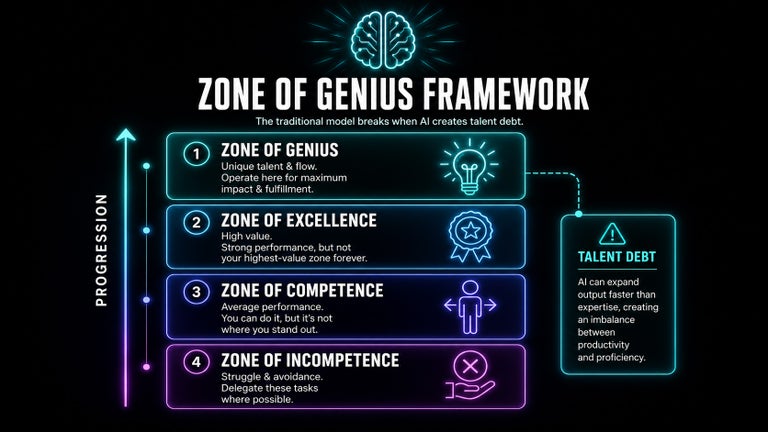
AI can remove the work outside of your Zone of Genius. But it can also remove the work that would have helped you discover and reach it.
When that happens, productivity surges while proficiency snail-trails behind. You produce more, cross into new disciplines and deliver results that look sophisticated.
But the way you understand the work doesn’t keep up.
That gap is called talent debt.
And remote work makes it easier to accumulate. Roles are expanding, expectations at work are rising and tech workers being trusted with more autonomy across unfamiliar territory. AI helps folks meet that new baseline.
For some – it’s also doing this at the expense of their careers.
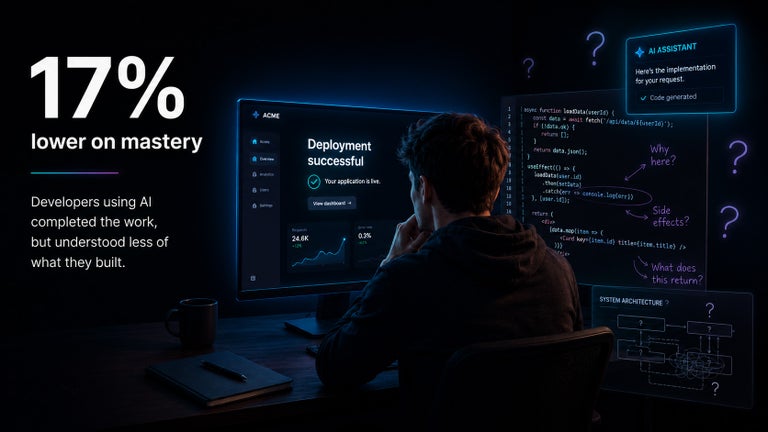
- In one controlled Anthropic study, developers using AI scored 17% lower on mastery. They completed the work but understood less of what they’d built.
Inside the heart of this article, an uncomfortable question… when AI helps you get ahead, what are you leaving behind?
The reality is - you can’t automate professional development.
You really don’t want to wake up one day to discover that your agents have become more advanced while your talent has stagnated.
In this article, I’ll unpack how talent debt is created, why your Zone of Genius needs continuous training and how to use AI to build real expertise instead of borrowing the appearance of it.
Agentic Workflows and The Rise of Talent Debt
Talent debt is real.
And it affects people far beyond their early career.
In 2023, two New York Lawyers - Steven Schwartz and Peter LoDuca – submitted a legal brief brimming with cases that didn’t exist. ChatGPT had created them from thin air, complete with convincing names, quotations and judicial details.
The pair filed the work without verifying it, then had an extremely rough time defending the fabricated nonsense when the court challenged them.
They were eventually sanctioned and fined (and horribly embarrassed).

Lawyers are notoriously busy people, known to eat, sleep and exercise at work. Of course they’re going to use AI to get ahead. Sadly, AI expanded their productivity – but not their judgement or expertise.
They were totally in the dark about their own work.
Similarly, a young coder, fresh from college builds their first big product using AI. It sets up the architecture, writes code, fixes errors and does all the hard things.
Their team lead is super impressed – what a huge amount of work for such a young coder! Then something breaks. Agents try everything, and nothing works. The coder sits wading through the database, but he has no idea what he’s looking at.
He used AI to create the product, but he didn’t fully understand how.
When you create something, you own it – you are the expert on its design. We’re handing ownership to agents completely oblivious to the fact that it’s eroding our expertise.
That’s talent debt.
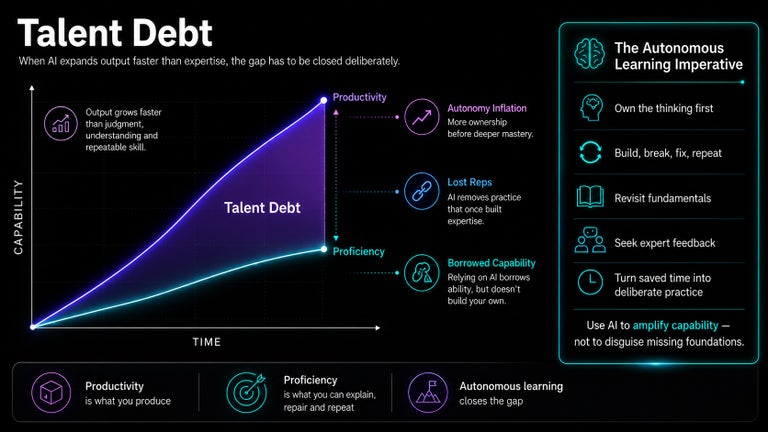
The gap between the work you can create with AI, and the capability you’ve developed to understand, challenge, repair and reproduce it yourself.
It’s a nicer name for AI-induced epistemic debt - a term that researchers use to describe knowledge that appears to belong to someone, but was never truly earned or absorbed.
In one revealing 2026 preprint involving 78 novice programmers, unrestricted AI users matched the productivity of people using structured AI support.
Later, when the AI was removed, they failed 77% of a code-maintenance task. The researchers called this a ‘false floor of competence’ – we know it as output sitting on top of weak corrective ability.
Expertise you see, isn’t only about the working thing we create. The strategy that brings in 8000 new followers. The product roadmap that surfaces amazing budget improvements, or the analyst who submits incredible AI-assisted reports.
If you don’t have authentic expertise on these parts of YOUR work, you’re accumulating talent debt. And when someone comes to collect, you’ll be broke.
AI can automate so much. But it really can’t automate things like years of judgement, taste, experience, ideas, or your understanding of your job.
It impacts everyone using AI.
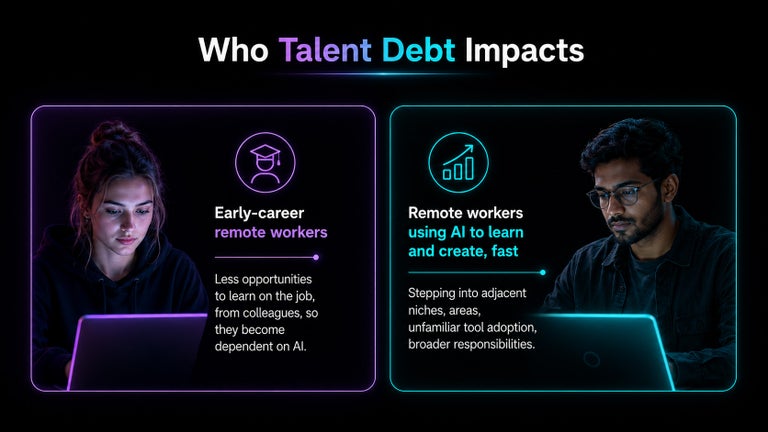
- Early-career remote workers (Less opportunities to learn on the job, from colleagues, so they become dependent on AI).
- Remote workers using AI to learn and create, fast (Stepping into adjacent niches, areas, unfamiliar tool adoption, broader responsibilities).
I’ll say it again – AI expands the appearance of capability BEFORE it expands your actual capability. That second part, is where the real work comes in.
Once you’ve created momentum with AI, you need to compensate by filling in the learning gaps. If anything, AI has made constant, life-long learning a major priority for any AI expert users today. Without it, your talent debt starts charging interest.
A new business direction, a new toolset, a new process. Your dependence on AI will be so great that without it, you no longer have a Zone of Excellence.
And this is the training problem I spoke about earlier.
It’s important to use AI to expand your Zone of Genius. But use it incorrectly, and instead you’ll just expand your dependence on flighty toolsets that one day won’t exist.
We all have to travel the road from incompetence to competence, doing the boring, messy work. The unglamorous stuff that we disliked and took us away from our genius zone. Without the mess, how do we grow?
The Zone of Genius Framework (Using AI to Boost Talent)
Your Zone of Genius is back - but the old model doesn’t work anymore.
It assumes expertise develops first and automation comes in later. AI has turned that sequence on its head.
The ‘Zone of Genius’ concept has resurfaced recently from author Gay Hendricks to do its rounds. Tech folks have always wanted meaningful work that pays well, so you can see the appeal of amplifying this promise.
When your natural talents and greatest passions come together in perfect flow and harmony…it produces exceptional work that you love to do.
Fantastic, right?
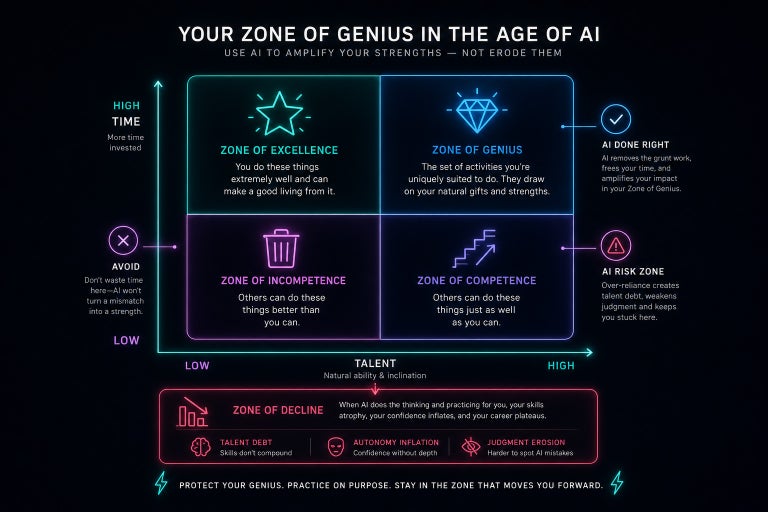
The idea is similar to Ikigai, or The Hedgehog Concept from Jim Collins (a personal favorite of mine) and even Malcolm Gladwell’s 10,000 hour rule of mastery.
Each offers a different route towards a common destination. You find the work you’re unusually suited to do, develop mastery and focus more of your career around it.
And yes, AI can supercharge your progress.
It does genuinely remove repetition, accelerate experimentation, unlock possibilities with adjacent disciplines and lets you dabble in problems once well beyond your reach.
As a writer who is now a fairly proficient coder, I’m evidence of this. AI helped me cross into coding much faster than I could have done alone. But it didn’t remove my responsibility to understand what I was building.
Your Zone of Genius isn’t some magical AI-proof place you can find and settle into.
In tech, it’s a moving capability consistently built through practice, proven through repeatable results and expanded through continuous learning.
Traditionally folks have travelled from incompetence to competence, then from competence to excellence. On that messy journey, they discover the patterns, strengths and instincts that help them realize their Zone of Genius.
AI can divert you from that journey…a lot.
The promise becomes dangerous when we confuse access to a new field with expertise in it.
So, here’s a new framework for understanding what happens when AI-assisted output moves faster than the person behind it does.
Think of these as four possible relationships between your capability and your AI.
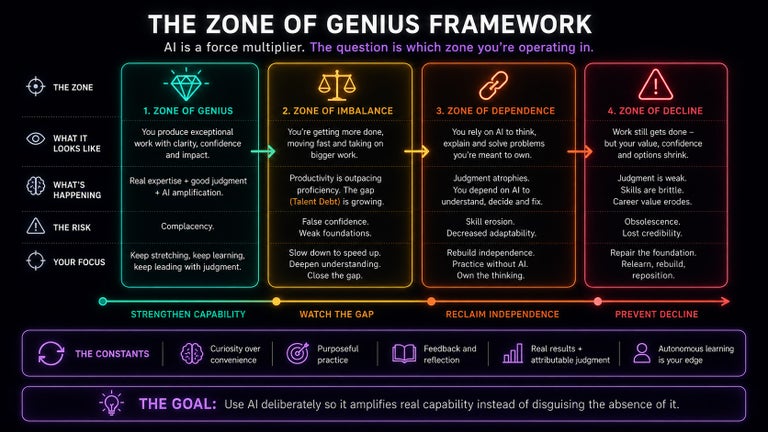
- The Zone of Genius is where AI amplifies expertise you already own. You can direct the tool, question its output, spot weak thinking and improve the result because the judgment underneath the work is yours. Here, AI removes friction without removing understanding.
- The Zone of Imbalance begins when productivity grows faster than proficiency. You can suddenly produce more, move into adjacent disciplines and deliver work that looks advanced, but your ability to explain, evaluate or repair it is still catching up. This is where talent debt starts accumulating.
- The Zone of Dependence appears when that gap stays open for too long. The work still gets done, but your agents increasingly hold the mental model. You need them not only for speed, but to understand the systems, decisions and processes you are supposed to own.
- The Zone of Decline is where the debt finally starts collecting interest. Your judgment circles the sink, your skills become less portable and your confidence rests on tools that can change, fail or disappear. You still look capable, right up until the conditions shift and the borrowed capability falls away.
The four zones show your career trajectory potential. Three forces determine which direction you travel in.
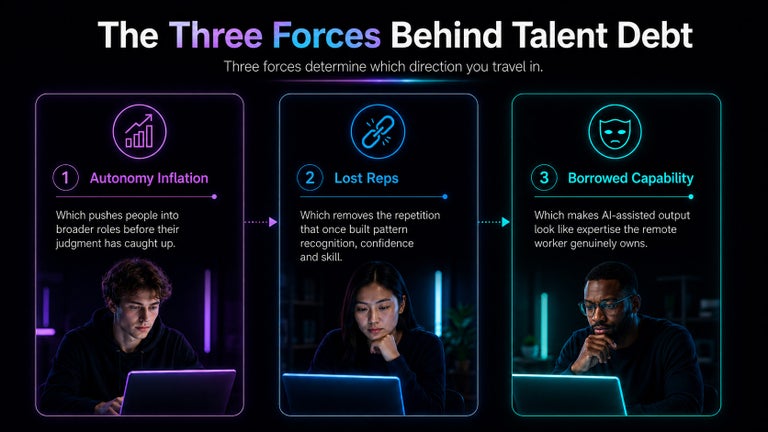
- Autonomy inflation - which pushes people into broader roles before their judgment has caught up.
- Lost reps - which removes the repetition that once built pattern recognition, confidence and skill.
- Borrowed capability - which makes AI-assisted output look like expertise the remote worker genuinely owns.
Your AI makes your output easier, but it doesn’t make your expertise easier. So, the real challenge is to stop productivity from outrunning proficiency.
That means becoming much more intentional about what AI does for you, what you still need to learn and how you prove the thinking behind your work.
#1: Become Your Own School
Remote roles are changing.
Folks are being asked to make bigger decisions, cross into adjacent disciplines and take ownership of work that once belonged to several super specialists.
AI makes that possible sure, but it also creates the persistent illusion that broader output automatically = broader capability. No, it’s doesn’t, sir.
I call it autonomy inflation - when responsibility expands faster than judgment.
The solution isn’t to wait for your boss to build the perfect training program. It’s not possible with today’s rate of change anyway. You need to become your own school!
*Cue dramatic music.
In a recent Crossover poll, 86% of respondents said keeping their skills current was their own responsibility, while only 14% placed that responsibility on their employer.
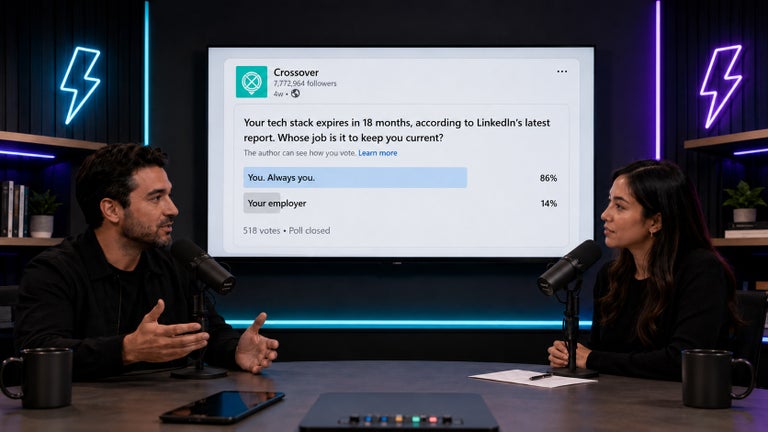
Clearly, it’s time to take DAILY autonomous learning and upskilling more seriously.
Create a personal curriculum around the problems your job is dealing with at the moment. Revisit those boring fundamentals. Create projects that challenge your logic and creativity, not just your output.
And actively seek out feedback from people who know more than you do. Team members, mentors, online learning groups.
AI will keep changing the syllabus. Your career depends on your ability to keep understanding the parts of your job that are easy to glaze over with AI.
#2: Build, Break, Fix, Repeat
AI removes repetitive work like nothing we’ve ever seen before. The problem is of course that some repetition is training.
It teaches you how to recognize winning patterns, spot weird decisions, recover from heart stopping mistakes and generally understand what top work looks like.
When agents complete every difficult step, they can remove the developmental reps along with the drudgery. Don’t let it get you into that red zone.
Practice really does create talent.
Kathy Slowinski’s team over at Trilogy has invested roughly 55,000 working hours in AI, with some super committed folks reaching an estimated 5,000 to 7,000 hours. Even then, she doesn’t confuse frequent use with expertise.
If 10,000 hours makes you an expert, no-one in the world is there yet with AI. We all need to be treating the change in our work with AI as a cultural shift.
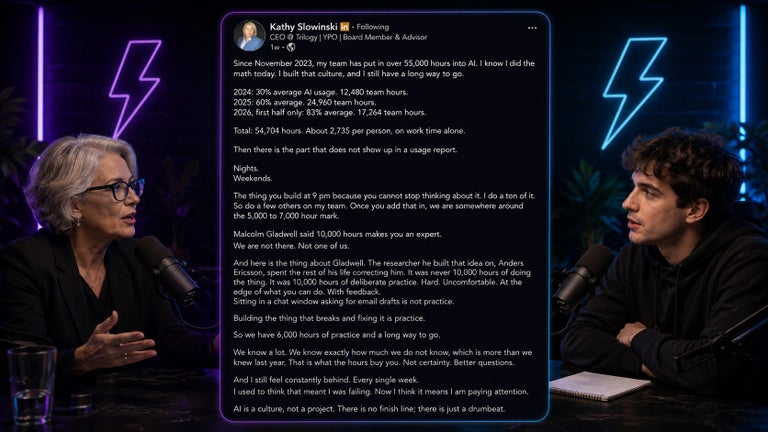
It’s not going to go away. So, adopt the drumbeat of experimentation and adaptation.
Build something ambitious, watch it fail enthusiastically, diagnose the problem and fix it to create the judgment you need. It’s your job to preserve the learning function, even when the task vanishes.
Attempt important decisions before asking your agents. Test the output. Break it on purpose. Compare your reasons with the agent’s recommendation. Disagree with your agents. Document failures as carefully as your successes.
Hours don’t buy certainty in AI, they buy better questions.
Become a habitual master AI experimenter – a mad scientist of AI in your Zone of Genius. It will keep you on your toes and in-the-know.
#3: Make Your Results Prove Your Talent
AI makes good looking end results terrible evidence of ability these days.
A strong strategy, or software build can come from anywhere – deep personal expertise, shallow, cobbled together understanding, or a series of agents doing most of the thinking. No-one really knows but you.
From the outside, the end results can look identical.
But it’s borrowed capability.
It’s important that you make your judgment visible around the things you do with AI.
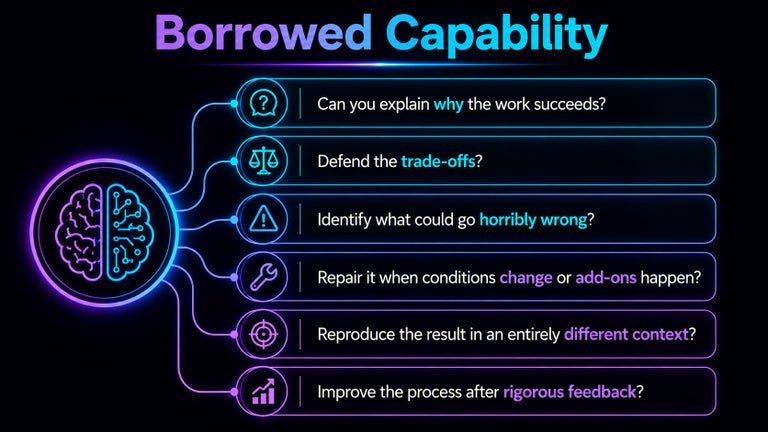
- Can you explain why the work succeeds?
- Defend the trade-offs?
- Identify what could go horribly wrong?
- Repair it when conditions change or add-ons happen?
- Reproduce the result in an entirely different context?
- Improve the process after rigorous feedback?
That’s the difference between output you’ve delivered and expertise you own. For remote workers, this matters more than you know – your career value is tied to it!
Managers often see the final result without seeing the thought process behind it. So, take the time to document key decisions, show your reasons and make it clear where your judgment has positively changed the outcome.
AI will help you produce one excellent result. Talent is being able to explain it, adapt it and do it again.
Your Zone of Genius Has to Be Balanced
You have a second brain now, perhaps many of them. They can take you all the way up or confuse your career out of existence.
Most of us just want less drudgery, some meaningful work, and a bit of time to spend doing the things we love. That’s why the Zone of Genius idea lands so well. It gives us permission to believe that work can be energizing, creative and rewarding.
And it can be, with AI as your career ally.
But the shift has to be intentional, cultural and consistent.
Productivity CAN surge basically overnight, we’ve seen it. Proficiency can’t do that – it naturally trails behind. Pretending that it doesn’t is a recipe for disaster, yet so many people are being forced (or are choosing) to just go with it.
Don’t be one of them. There are far reaching consequences for your career.
Good judgment still has to be forged under pressure, taste still depends on wide and repeated exposure, and expertise is still earned through the stubborn cycle of trying, learning, adapting and giving the problem one more shot.
So be careful what you automate away.
When productivity rises and proficiency along with it, AI expands your talent. You become faster without becoming shallower. You take on broader work without losing your grip on the fundamentals.
Your Zone of Genius grows because the person behind your AI is growing too.
But when productivity skyrockets upward while proficiency flatlines, the scales tip. Talent debt builds. Autonomy becomes performance pressure. Lost reps turn into lost and forgotten instincts. Borrowed capability stands in for expertise you can defend, repair and reproduce.
That’s why autonomous learning matters so much now.

It helps you grow into the bigger, more complex work your agents make possible. Habitual experimentation replaces the practice automation removes. And documenting your process proves that the final result reflects your judgment, not just the capability of your agentic workflows.
Your Zone of Genius was never meant to be a hiding place from learning. But if you stay passive it will eventually become your Zone of Decline.
That’s the real risk when using AI for your best work.
It literally makes us so productive, we stop noticing that we aren’t growing in ways that matter.
So, keep the scales balanced.
Let AI raise the ceiling on your work but never forget to raise the floor beneath your talent too. That’s how your career will keep climbing, long after everything else has changed.
Similar post


Want to read more?
We have a lot more where that came from


 AI-first education leaders.