Contents
- Way #1: Match the Difficulty to the Student
- Way #2: Catch Learning Gaps Early
- Way #3: Gate Progress on Mastery
- Way #4: Adapt the Explanation to the Learner
- Way #5: Make Support Available Anywhere, Anytime
- How to Judge AI in Special Education
Most conversations about AI in special education start with the tools: an app for dyslexia, one for autism, another for ADHD. But a tool per label leaves the underlying educational model untouched. Your students are not hitting the limits of their diagnosis - they’re hitting a delivery system that runs one pace, one mode, and one calendar for thirty unique brains.
The biggest opportunity in special education right now is using AI to remove the constraints that make the classroom inaccessible in the first place.
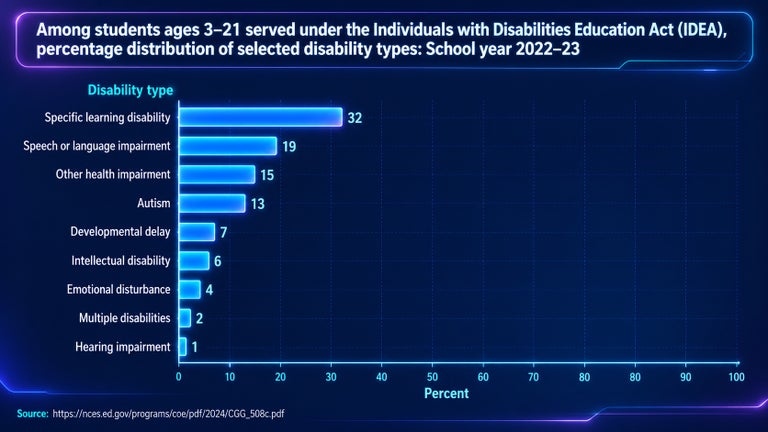
In 2022-23, 7.5 million students in US public schools received services under IDEA (Individuals with Disabilities Education Act). That’s 15% of enrollment, sitting in classrooms designed around an 'average student' that does't exist.
Founder of 2 Hour Learning, Mackenzie Price, describes the traditional classroom as handing every child the same lens and calling it fair.
If the prescription doesn't match, the child spends ten years squinting at the board, and somewhere in the middle of those ten years stops blaming the lens and starts blaming themself.
Fixing that was never a question of effort, because there has never been a teacher in the world with the time or space to grind thirty different lenses for their classroom.
So, does the evidence back AI as the fix? Yes… but it’s worth stating the honest size.
Across 29 experimental and quasi-experimental studies of artificial intelligence-based interventions for students with disabilities, the pooled effect came out at Hedges’ g = 0.588, a medium effect. Correct that for publication bias with trim-and-fill, and it settles at g = 0.269.
A bit smaller. Still very real. And certainly enough to make the mechanism worth understanding.
What separates a mechanism from a gadget is the constraint it removes. Here are the five ways AI in special education is here to help your kids.
Way #1: Match the Difficulty to the Student
Every teacher worth their salt already knows the sweet spot of true learning. Hard enough to demand effort, easy enough to be achievable.
Vygotsky named it the Zone of Proximal Development. It's quite possibly the least controversial idea in education.
It’s also the one thing a single adult in a room of thirty can’t reasonably deliver. Sure, you can hold a limited number of students there for a second. But, not all of them. Not for a full period. And certainly not while also running the door, the paperwork, and the clock.
So the lesson goes out to the middle of the room.
Students above it coast and call it boredom. Students below it fall behind at the exact rate the lesson is delivered. And nobody records that happening, because a lesson that was taught looks identical to a lesson that landed until the results start rolling in weeks (or months) later.
Adaptive difficulty - only achievable at scale through AI - removes the single-pace constraint by giving every student an individually planned, continuously adjusted learning path. Three fast, correct answers and the material escalates. A stall on one step and the system drops back, rebuilds the prerequisite, then returns to the point of the stall.
The room stops sharing a pace and starts sharing a target.
Specific learning disabilities are the largest IDEA category at 32% of students served (2022-23), covering dyslexia, dyscalculia, and dysgraphia. For these students, the barrier isn’t a physical one.
What stands in the way is the speed at which decoding is expected to become automatic, and the time available to vary difficulty to the individual.
Speed and variability are two human constraints AI can handle at scale.
Way #2: Catch Learning Gaps Early
Every misunderstanding starts somewhere. A specific moment when a student first applies the wrong rule, gets away with it, and files it as correct.
In a class of thirty, that moment passes unnoticed. The error surfaces three weeks later on a unit test, already practiced into place and built on twice. Re-teaching at this point costs more (in time and confidence) than a day one adjustment.
Continuous monitoring doesn’t remove the error. It removes the lag.
Software watching a student work reads things a marking pile can’t. How long the pause before an answer runs. Whether the second attempt came faster or slower. Which specific step in a four-step procedure the hesitation always lands on.
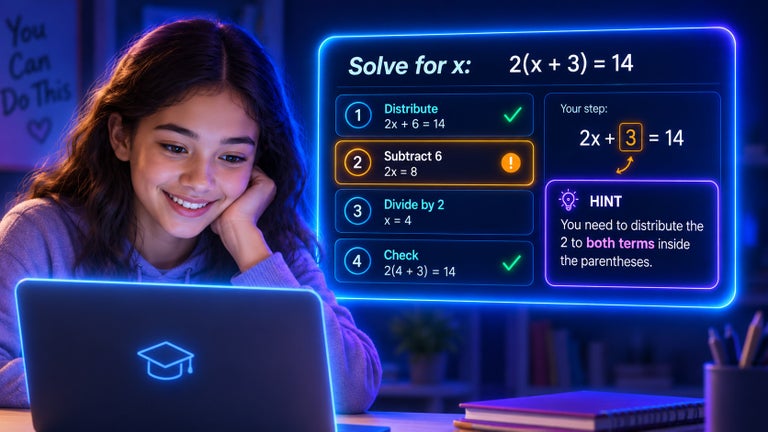
That level of monitoring offers educators a signal per student per minute, on every student at once, and none of it waits for a hand to go up.
That’s a game-changer for the quiet kid trying to 'deal with it' alone.
The student who asks for help gets help. The student who never asks - who copies the worked example neatly and hands in something that looks fine - accumulates unrepaired gaps precisely because nothing immediately visible ever happened.
Compliance reads as comprehension. And plenty of students with learning differences worked out years ago that looking fine is safer than asking twice.
Continuous monitoring supports students whether or not they ask. Reading the work and acting in that moment.
Way #3: Gate Progress on Mastery
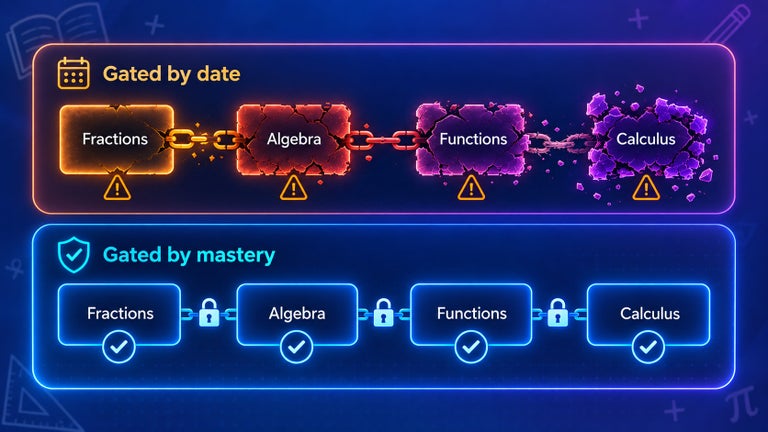
Subjects - like math and science - are built on layered knowledge. Fractions in fourth grade. Algebra in seventh. Functions in ninth. Calculus in twelfth.
Miss the first link and the chain slowly degrades over time.
Every new topic is a little harder to hold. Homework takes longer for a worse result. And somewhere along the line, the student stops describing the work as a hard and starts describing their gap as an identity.
‘I’m bad at math’ is almost never a statement about ability. It’s a statement about unrepaired scaffolding, made by a student who was pushed along based on a date rather than personal evidence.
Age-based promotion is what builds that chain. A system moving thirty students at once has to move them together, so it uses the only clock that applies to all of them equally.
Mastery gating swaps the clock for a standard.
A student learns at their own pace and advances by demonstrating mastery, never before. If a gap emerges, it gets repaired at the point it appears, at whatever cost in days it takes. And the days are available, because we’ve removed the September start date as load-bearing.
Case in point are schools running the 2 Hour Learning mastery-gated loop. These schools - schools like Alpha - report students learning 2.2-3.9x faster than a conventional model WHILE patching the knowledge gaps that are holding them back.
Those are whole-school figures, and they are not broken out by disability.
So read them as evidence of what removing the calendar and adding mastery does, not as a result measured on students with IEPs. The claim they support is narrower.
When progression stops being time-boxed and starts being gated, a student with a disability can comfortably take the days they need to master the content without falling off the map.
Way #4: Adapt the Explanation to the Learner
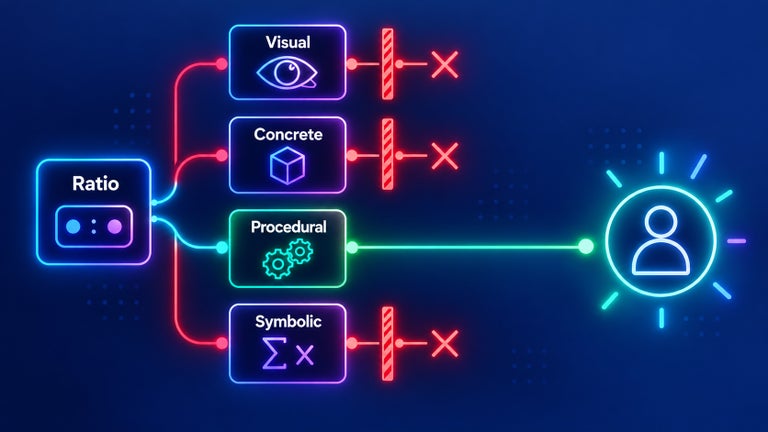
There’s no single explanation that works for every learner. Take ratios: one student may grasp the idea through a scaled drawing, another through doubling a recipe, another through a step-by-step procedure, and another through a formal definition. The concept stays the same, but the route in can be entirely different.
A teacher working in general education settings has one voice and a hard timeline, so they pick a direction and commit. Everyone who needed a different door waits for the recap, or the homework, or a parent at the kitchen table.
Software has no such limit.
It can present the visual version, register that the student has started guessing, and re-present the same concept procedurally inside the same session - without anyone having to admit anything. A tireless teaching chameleon, changing form as often as the evidence says it should, with no ego invested in the first explanation.
None of this is a new idea. It’s a newly affordable one.
CAST built the Universal Design for Learning (UDL) framework around exactly this: multiple means of representation, multiple means of action and expression, multiple means of engagement.
Engagement in CAST’s sense is all about whether a student can sustain effort on this task, in this format, long enough to finish it.
UDL has been the right answer for decades but largely unaffordable for most schools, because a single teacher producing four versions of every lesson is a workload problem no policy has ever solved.
Captioning, speech-to-text and read-aloud belong here too.
Sorted by label, they look like a separate shelf of assistive gadgets. Sorted by mechanism, they’re the same move applied to the input channel instead of the explanation.
They stop being special equipment for some students the moment they’re available to all of them.
Way #5: Make Support Available Anywhere, Anytime
Support has always been rationed by logistics.
The reading specialist works Tuesdays and Thursdays. The tutoring block runs after school, which requires a ride home at four. And the student who needs the most help is frequently the student whose family has the least slack to deliver them to it.
Remove the requirement to be in a particular room at a particular hour, and the ration disappears. Help from an AI tutor at nine on a Sunday night costs the same as help at eleven on a Wednesday morning.
A student managing a chronic condition works in the hours they have. A student carrying a caregiving responsibility at home works around that.
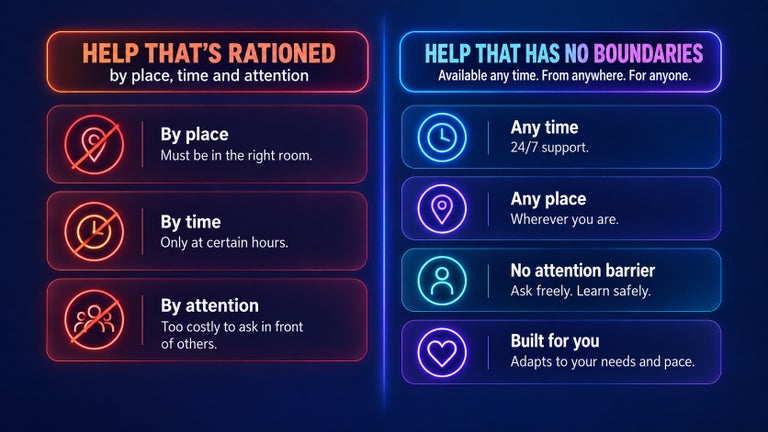
Then there’s the boundary nobody counts as a boundary: attention.
Asking a question in front of twenty-nine peers carries a social price. For a student with social-emotional needs or a communication difference, that price is high enough to keep the question permanently unasked.
Neurodivergent students raise a different question. Hyperfocus, pattern recognition, and an ‘unusual’ tolerance for repetition are real cognitive assets. But a classroom built on synchronized attention trains all three out of a student by treating them as a behavior problem.
Software charges nothing for the sixth attempt at the same question, or a time and attention adjustment that fits a natural cognitive process.
How to Judge AI in Special Education
The only test that matter for AI in special education is whether using it makes learning more accessible... simple as that.
When you look at a new tool, ask five questions:
- Difficulty: Does it adjust to the student?
- Learning gaps: Does it catch misunderstandings early?
- Progress: Does it gate progression on mastery?
- Explanation: Does it adjust delivery for the student?
- Support: Does it enable students to get help when, where, and how they need it?
A tool built for one diagnosis can still be useful. But the bigger opportunity is structural: a learning environment that can change pace, catch gaps, adapt explanations, and make support available without asking every student to fit the same shape.
AI is finally giving schools a practical way to change learning without treating the child as something that needs fixing. It’s time to unlock that capability.
Want to help build a more accessible era of education? Apply now for an education role through Crossover.
Similar post


Want to read more?
We have a lot more where that came from






 AI-first education leaders.