Contents
- Test #1: AI Keeps the Plan Current
- Test #2: Each Subject Gets Its Own Pace
- Test #3: Progress Is Gated on Mastery
- Test #4: Every Student Has a Named Human
- Most AI Still Stops Short of a Live Plan
- What a Live Personal Learning Plan Gives Back
A personal learning plan is meant to change as the student changes. Yet in many schools, the plan written in September sits untouched until the next formal review. AI hasn’t fixed that. Most schools only use it to make the same static document faster. Four things separate a plan that’s live from a plan that’s filed - and you can run all four on any learning plan in the building by Monday.
Every personal learning plan you’ve ever written was accurate on the day you wrote it. And that’s about where the accuracy stopped.
Then the semester started moving.
The student who needed scaffolding in fractions stopped needing it. The one who was behind in reading closed most of the gap by winter. And nobody re-opened the file to say so.
By the annual review, the document describes a child who had moved on from it months earlier. And it gets signed anyway, because the review is a compliance event at best and the plan is just the doc you happen to bring along for the ride.
That’s not a follow-through issue.
The plan stopped being deliverable in October for a reason that has nothing to do with anyone’s commitment. Thirty students move at thirty paces. One adult stands in front of them with one sequence, one set of materials, and one clock.
You can write thirty gorgeous, individualized plans. And not one of them will change what happens in a classically constrained classroom.
The document was never the weak part of the system. Delivery capacity was.
Lift that constraint and everything moves. Leave it, and nothing does.
Which is exactly why classroom AI matters so much. And exactly why superficial implementation has mostly left learning unchanged.
Teacher AI use has nearly doubled, climbing from 32% in 2024 to 61% in 2025.
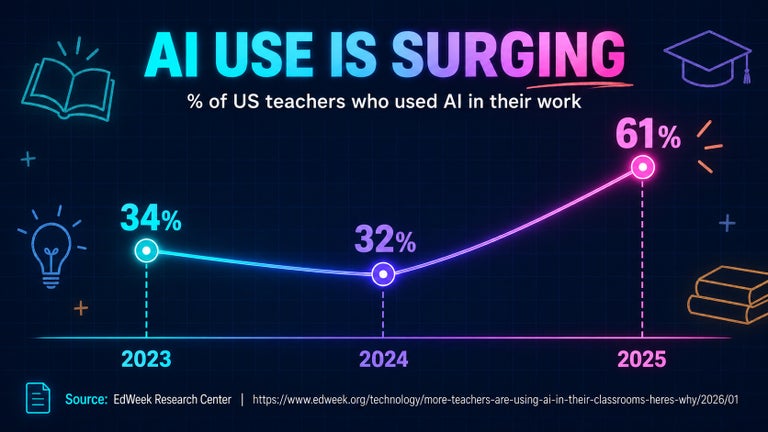
What it arrived to do is a whole separate question. And in most buildings, the honest answer is that it made the same filed document faster to write.
A plan that’s genuinely live is a different animal from a plan that’s well written.
The former gets reset against evidence continuously. It holds a separate pace for each subject. It refuses to advance a student who hasn’t demonstrated the skill. And it puts a person the student can name on the other side of it.
These four tests are the steps to creating a genuinely live personal learning plan. Fail any of them, and all you get is a static document with better ‘AI-forward’ branding.
Test #1: AI Keeps the Plan Current
AKA: The plan changes as the student does.
Creating a personal learning plan relies on the accuracy of the evidence underneath it. Assess once a year, and your instructional planning only gets updated once a year, no matter how elegant the plan or how sophisticated the tool that wrote it.
That’s why the September document goes stale. It was built on a snapshot, and progress doesn’t sit still.
So the first test is about cadence, not content. Is the diagnosis a scheduled event, or is it actively running?
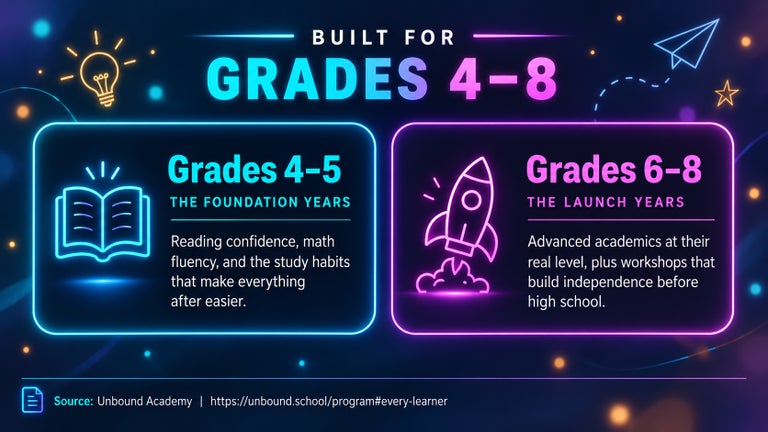
At Unbound Academy - an Arizona virtual public charter serving grades 4 through 8 - it runs.
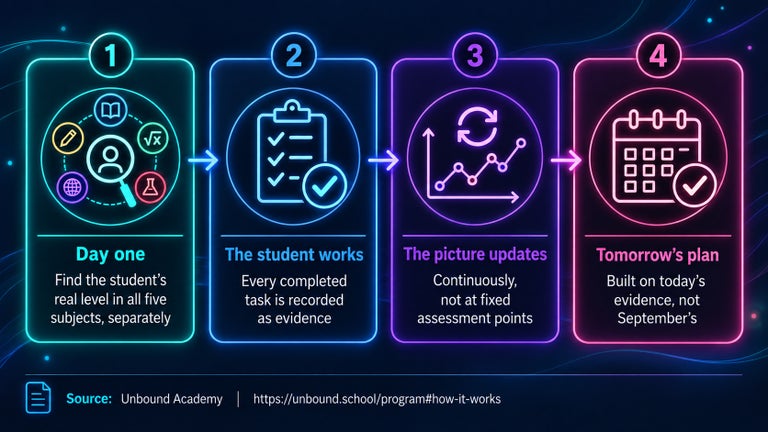
Unbound starts by finding each student’s actual level across all five subjects on day one, rather than assuming it from their grade or carrying forward an old score.
That matters because a fourth grader is rarely at a neat fourth-grade level in everything. They can be flying in reading and struggling in math, while a single grade-level label averages both into a tidy number that describes neither accurately.
From there, the measurement simply never stops. Every task the student completes is evidence. The picture updates while they work. And they get a plan based on where they are this morning, rather than where they were in September.
Now, I hear you. You’ve likely heard ‘AI-first school’ before, and it came with a price tag.
So, worth putting extra emphasis on ‘public charter’. Unbound is tuition-free and state-funded. No admissions fee. No parent writing a check for the version of school where the plan is real.
AI-powered personal learning CAN be for everyone. Continuous diagnosis is the non-negotiable plumbing it runs on.
Test #2: Each Subject Gets Its Own Pace
AKA: Reading and math don’t have to move together.
A student rarely needs the same pace in every subject.
When a child is flying in math and stuck in reading, a single pace either holds the math back to protect the reading, or drags the reading forward to keep up with the math.
Unbound describes its own operating model as a personal plan per subject - adjusted every single day to their level and learning style. Instead of waiting for a quarterly review, each plan resets against what the student did the day before.
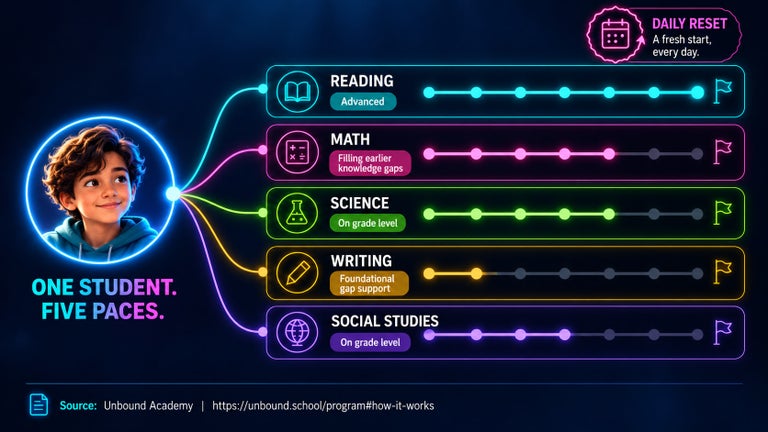
And that daily reset has to work in both directions.
When a student clears a unit, the plan accelerates - they don’t sit out the rest of a module they’ve already finished, tapping their pencil while the calendar catches up.
When a student doesn’t clear it, the plan holds and the learning experience adjusts, bringing the material back from a new angle rather than repeating the same explanation slower and louder.
Same evidence, opposite responses.
And that subject- and student-level tuning does serious work. Unbound reports its students learning 2.8x faster than the norm on NWEA MAP Growth while wrapping core academics by 11AM.
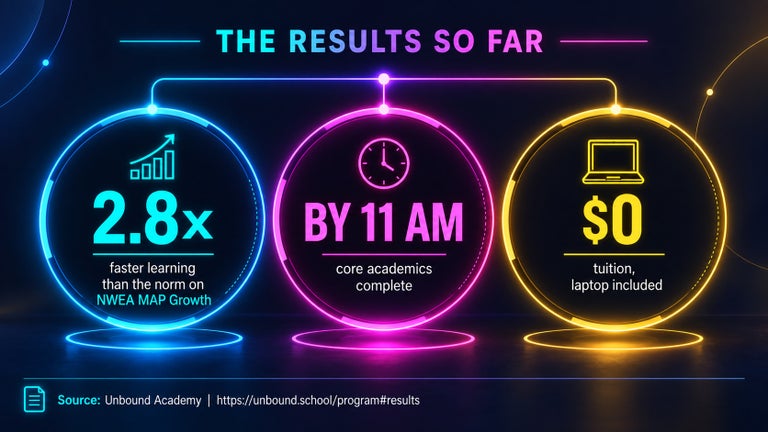
That kind of personal growth only becomes possible once pace is a variable the system controls, instead of a constant the calendar imposes.
Test #3: Progress Is Gated on Mastery
AKA: The calendar doesn’t decide when students are ready to move on.
Everything so far describes a faster plan. But speed on its own is not a virtue, and this is precisely where a lot of AI-driven pacing goes off the rails.
Move a student forward because the module ended and you’ve built a checklist, not a plan.
The gaps don’t close. Over the long term, they compound underneath and surface two years later as ‘struggles with algebra’ - when what actually happened is that a fraction concept never landed in fifth grade and everything stacked on top of it has been wobbling ever since.
So the third test is a single question: What learning goals have to be demonstrated before a student advances?
And the answer has to be a demonstration.
Unbound’s own answer sits well above state mandates.
Arkansas requires a 60% pass rate on its exams. Unbound requires students to demonstrate mastery of each concept through repeated in-app testing - at roughly 90% accuracy - before they lay a finger on new material.
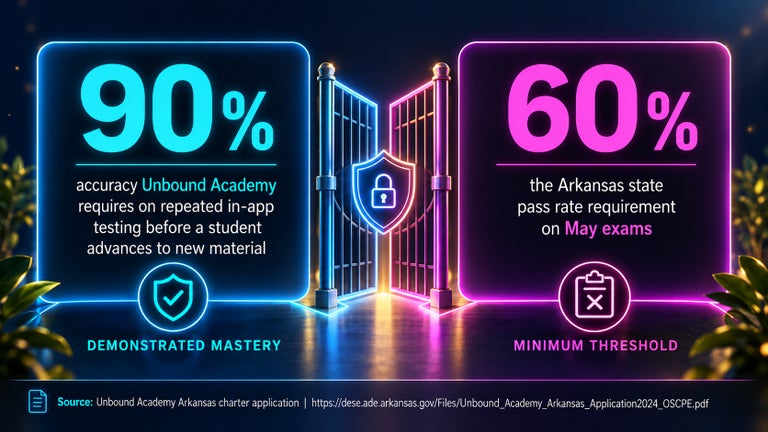
The distance between those two thresholds is important. One treats a passing score as permission to move on. The other treats demonstrated mastery as the only permission that matters.
Adding a high bar is what makes acceleration honest.
The uncomfortable part? A real mastery gate will sometimes hold a student in place while their cohort moves on. But the mistake is thinking that’s a flaw… IT’S NOT. It might not be pretty, but it's the foundation that true mastery is built on.
Unfortunately, it’s also why so few systems that claim mastery are actually willing to run it.
Test #4: Every Student Has a Named Human
AKA: Someone has to see what the data can’t.
A plan the student can’t engage with is optimization performed on them.
Students hold the one variable nobody else can measure: whether the optimization is working for them in the moment.
A system can tell you a child answered a set of questions correctly. It can’t tell you they were guessing. Or that they understood the concept a week ago and are now bored senseless. Or that reading collapsed on Thursday because of something that happened at home on Wednesday.
So the student has to be able to look at the plan, ask why it says what it says, and argue with it.
That's a data source the mechanics don’t otherwise have.
Then comes the adult - and this is the half you should be watching for.
That adult in the room can’t exist only as ‘teacher oversight’ in a vendor deck. It has to be a specific person who steps in live when a learner is stuck, frustrated, or gaming the system, and who the student can name without having to stop and think about it.
This is why the traditional teacher role needs to change for the newer system.
With AI, the adult doesn’t need to be a raw delivery mechanism for content and can become the human who’s there for each and every individual child. It’s a harder, more impactful job that only a person can do.
That role also has to be paid for in hours, which is where the AI tools most schools already have start to count.
Among US K-12 teachers who use AI weekly, the self-estimated saving is 5.9 hours a week, measured on the RAND American Teacher Panel with a nationally representative sample of 2,232 teachers.
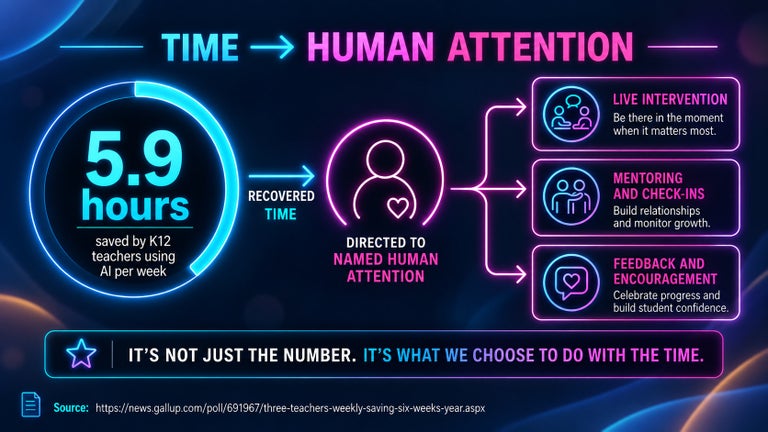
Self-estimates run generous, so hold that number loosely. But it’s still the right order of magnitude - for an average school - for the question that decides this test: is a named human’s attention a budget your school can afford, or a line in a brochure?
Freed hours don’t become human attention on their own. They become human attention when someone decides that’s what they’re for.
Most AI Still Stops Short of a Live Plan
All four tests together describe something that barely exists yet.
Start with the national picture.
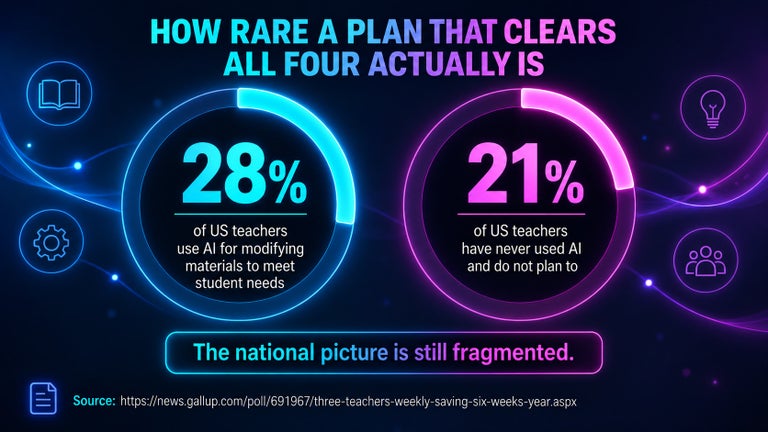
Roughly 28% of teachers report using AI to modify materials to meet student needs - the closest thing there is to a starting point for individualization of this kind.
That’s real work, and it's helping real children. But it isn’t a live plan.
It’s a teacher doing by hand, faster, the thing the system won’t do structurally.
At the other end, 21% have never used AI and don’t plan to. A fifth of the profession is out entirely - and any claim that classroom AI is a settled, universal change has to walk straight past that number to hold itself up.
The distinction worth holding onto is between two very different things that get lumped into the same group.
The first is AI that relieves adult paperwork: a powerful tool for drafting the plan, writing the report, and generating the differentiated worksheet or two. That’s genuinely useful, and it hands a teacher back hours they were never going to get any other way.
The second is AI that changes what a specific student meets tomorrow morning. Different content, different pace, different gate - because yesterday’s evidence said so.
Both are real, but only the second is a direct line to a personal learning plan for your kids.
Adoption is step one, which has largely already happened. Structural change is something else entirely.
A teacher can be a genuine AI user inside a school that has changed nothing about the thirty-paces problem. The tool is in their hands, but the room still needs changing.
What a Live Personal Learning Plan Gives Back
You can run these four tests on anything. A vendor demo. A district initiative. A tool your school bought two years ago.
- Is the diagnosis running, or scheduled?
- Does pace adjust per subject, or does the whole student move at one speed?
- Does advancement require a demonstration, or a date?
- Can the student name the human on the other side?
Four questions, and not one of them needs a procurement cycle to ask.
When developing a personal learning plan, anything that fails one can still be useful. It just isn’t a TRUE personal learning plan - and calling it one costs you the ability to tell the difference later.
If you want to build inside a school running true personalized learning, we want to hear from you. Apply now for an education role through Crossover.
Similar post


Want to read more?
We have a lot more where that came from






 AI-first education leaders.