Contents
- The Usual Objections Miss the Bigger Problem
- AI Can Improve Performance AND Reduce Learning
- We Can Measure the Harm Better Than the Benefit
- AI Didn’t Break the Classroom
- The Line Between Helpful AI and Harmful AI
- AI Works Only When Two Conditions Are Met
- Make AI Earn Its Place in the Classroom
If you want to know why AI should not be used in education, you don't need to look much further than what it's being used for MOST of the time. A wild amount of the AI being sold to schools is nothing more than a patch for an educational model that was failing long before generative AI entered the classroom. Weighing pros against cons won’t tell you which AI to accept and reject. Understanding the system it’s acting on will.
Ask why AI should not be used in education, and most answers collapse into the same familiar (and ambiguous) pros-and-cons list. The straight answer is that much of today’s hype-AI has no place in a classroom, and we finally have evidence showing why.
We've been hearing the same tired education arguments since ChatGPT first hit the scene back in 2022.
Critics point to cheating, privacy, bias and false information. Advocates promise that AI can make teaching more efficient and learning more personalized.
Problem is, both sides have been arguing from anecdote and personal feeling, because, until recently, the data just wasn't available.
That case has changed... for one side of the discussion.
New controlled trials are showing AI-powered assistance making students measurably worse at the subject they’re practicing. Brain imaging is being applied to map what happens when students outsource their writing. But the case for benefit is still woefully under-researched.
The objection to AI in education is evidence-backed, but it's also not the whole picture. The final verdict is far more complicated, and it points past the technology at the thing the technology is being installed into.
Hot take: the yes or no of AI in education depends entirely on what we ask it to do.
The Usual Objections Miss the Bigger Problem
Let’s start with the risks we’re all too familiar with.
Students hand in work they didn’t write. Detectors misflag honest kids. Vendors take student data and stay vague about where it goes. AI systems reproduce the biases of whatever trained them, and chatbots state falsehoods that a fourteen-year-old has no reason to distrust.
And every hour a student spends with a machine is an hour they don’t spend with an adult or building connection with their peers.
All of that is true. None of it is the argument.
Every item on that list describes something the technology does to a classroom. Which means every objection invites some version of the same response: improve the technology or tighten the rules around it.
Answer the objections one at a time, and you end up with a school that has solved five individual problems and installed the thing anyway.
Looking squarely at AI also breezes over the current state of K12 and higher education.
Cheating is only worth doing where the assignment is a paper trail rather than a demonstration. A detector is only necessary where the work happens out of sight. Lost contact time only hurts in a model that gave teachers almost none of it to begin with.
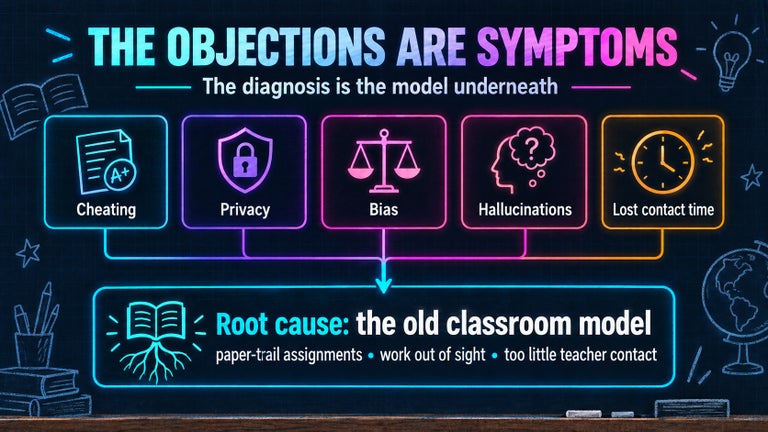
The symptoms cluster because they sit downstream of a single design. And that design is far older problem than AI.
AI Can Improve Performance AND Reduce Learning
The strongest single piece of evidence in the AI-education debate comes out of Turkish high school math classes.
And it’s a doozy. It’s a randomized trial (so gold standard research), and pulled apart two things schools routinely confuse.
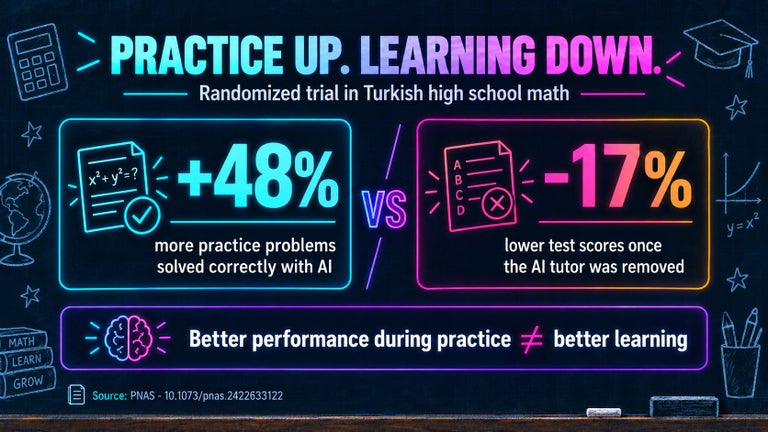
The study found that students given a ChatGPT-style tutor solved 48% more practice problems correctly than students working alone.
The practice looked excellent.
Then the tutor was taken away, and both groups sat a test on the same material.
The AI group scored 17% worse.
Read those two numbers as one sentence, and AI’s case doesn’t look good:
- Performance during the activity went UP.
- Learning went DOWN.
The researchers even retested on another variant where the AI tutor offered instant feedback, hints, and guardrails instead of straight answers. That group produced 127% more correct practice and still gained nothing on the backend during the testing phase.
Careful tool design bought better-looking work without building durable student learning.
And this isn’t one odd result in one subject. A review of AI over-reliance across the research found the same shape in 65.52% of studies.
AI helped the task get completed. It didn’t noticeably aid durable understanding.
We Can Measure the Harm Better Than the Benefit
A test score is only a proxy. The more revealing evidence hits at the thing the score stands in for.
Last year, a team out of the MIT Media Lab looked into cognitive debt coming from AI use. They put EEG caps on people writing essays and compared three conditions:
- unaided
- search engine
- ChatGPT
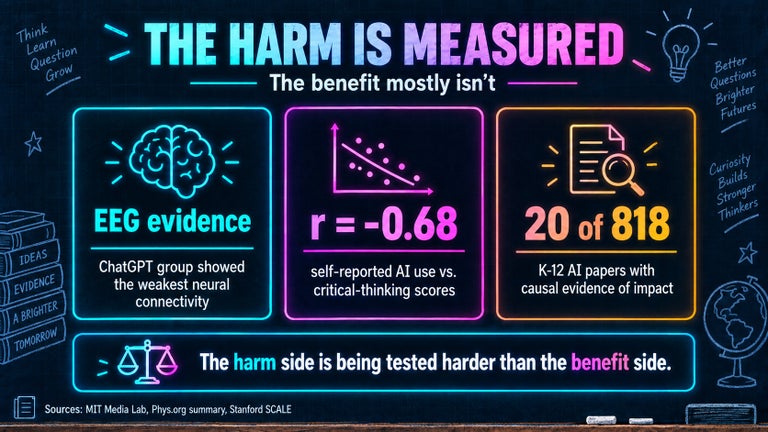
The ChatGPT group showed the weakest neural connectivity of the three. And when asked to quote a single line from the essay they had just submitted, most of them couldn’t. Nothing was retained because nothing was done.
The writing existed. The writer did not.
At population scale, the same pattern surfaces as a correlation. Self-reported AI tool use tracks with weaker critical thinking skills at r = -0.68, which in education research is a LOUD signal.
Now set the other side of the ledger next to that.
Stanford’s SCALE initiative reviewed the K-12 AI research base and found 20 of 818 papers carried causal evidence of impact on learning outcomes.
Twenty. Not twenty showing benefit or harm. Twenty built to show anything at all.
That asymmetry is the case in a nutshell.
The evidence of harm spans experimental, neurological, and population-level research. The benefit side is resting on a research base that has barely been stress-tested.
But evidence of harm only tells us what AI can do inside a classroom. It doesn’t explain why the classroom is so vulnerable to that harm in the first place.
AI Didn’t Break the Classroom
Here’s the part a pros-and-cons list never reaches: AI is not the problem.
The American classroom runs on a design more than a century old.
Age cohorts. Fixed periods. A bell oblivious to learning state. One adult delivering the same content at the same pace to thirty students - including students with disabilities - who walked in with wildly different prior knowledge.
Learning science has known for forty years that this is close to the worst available delivery mechanism.
We kept it because it was administratively convenient.
Then we saturated it with screens and watched what happened.
Students now spend 98 minutes a day on school-issued devices, over 20% of instructional time for grades one through twelve. And in 2025, the National Assessment of Educational Progress recorded the lowest 12th-grade reading and math scores in its history, with 45% below basic in math among seniors.
Access to technology went up. Outcomes went down.
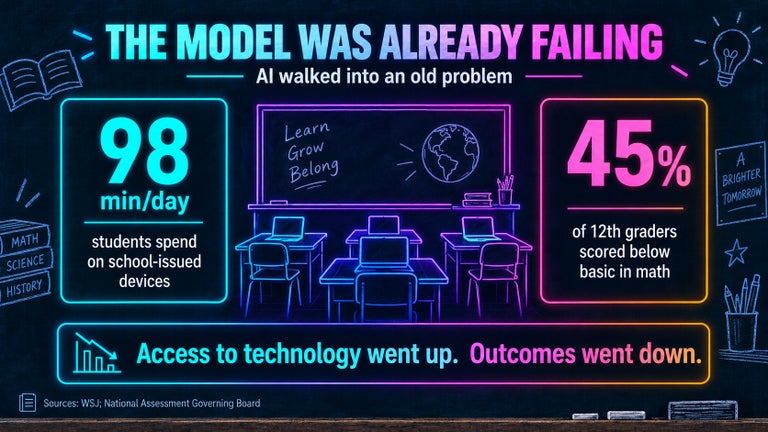
That was already true before generative AI arrived, which tells you what the new tools are joining rather than what they caused.
That said, I want to make something very clear. This is NOT a indictment on teachers
Put the best teacher you have ever worked with inside a system that hands them thirty students, six periods, almost no teacher time and a fixed pacing guide, and the system wins. That’s what a structural problem means.
The reality of the result is that it barely depends on who's standing at the front of the room.
It also explains why EdTech dashboards keep looking so healthy. Most of their headline metrics focus on participation rather than durable learning.
They measure activity inside the model. But spend very little time on whether a student can do the thing next month without the tool.
The Line Between Helpful AI and Harmful AI
Line the harms up, and they resolve into one mechanism.
The trial group practiced more and learned less because the tutor supplied the step the student was supposed to struggle through. The essay writers retained nothing because the sentences arrived already formed.
Microsoft’s own research found 70-80% of AI users report significantly reduced mental effort on the analysis and synthesis parts of a task.
That’s the product working as intended. Reduced mechanical work is literally the selling point of general AI.
The cost also lands in places a test never looks. A meta-analysis put the hit to idea diversity from human-AI collaboration at -0.86 across 28 studies.
Individual ideas got no worse. But the range of ideas collapsed.
Thirty students with a chatbot converge on a narrower band of answers than thirty students without one. And what disappears is the odd, wrong, productive answer a teacher builds a whole lesson around.
So there’s one question, and it works on any tool, any subject, any grade.
Is the student using this to build something, or to receive something?
Feeding thinking looks like a tool that makes the student do more of the work. It asks for the reasoning before it responds. It withholds the answer. It makes the process visible so a teacher can see in real time where it broke.
Standing in for thinking looks like fluent output arriving fast, completion rates climbing, and a student who cannot reconstruct on Tuesday what they produced on Monday.
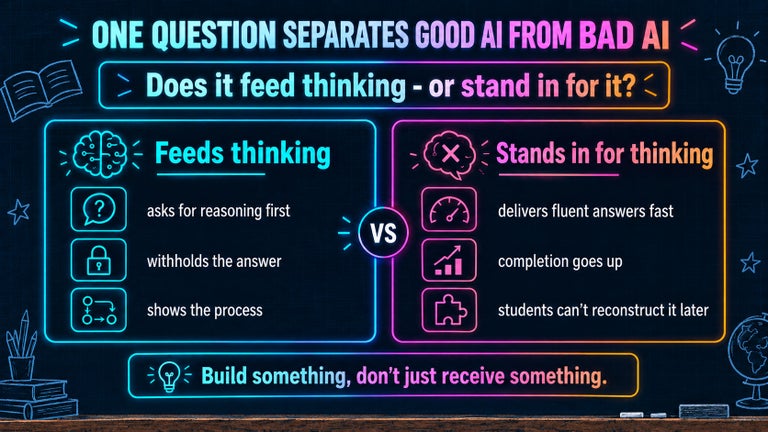
AI that delivers something is most of the market. When you start noticing the building kind, the path to useful AI becomes much clearer.
AI Works Only When Two Conditions Are Met
There is a version of AI in education that works. It’s narrow, and almost nothing on offer meets it… 👉ALMOST👈.
Condition one: academics get delivered through mastery-based personalized learning, set at the pace each individual student needs. No student sits through a lesson that was identical for everyone. No student moves on before they have the thing mastered.
We know what that ceiling looks like, and we’ve known since 1984. Benjamin Bloom found that students taught one-to-one under mastery conditions outperformed a conventional class of thirty by two standard deviations.
That paper is forty years old and still gets cited, because nobody has scaled the result. One tutor per child was never affordable.
Scalability was the entire reason the lecture won out, but, with AI, it ISN’T the constraint it was before.
Condition two: the time this frees goes to humans.
A TRUE mastery-based model with AI integrated into delivery can compress academic instruction into a fraction of the day. Refill those recovered hours with more software or lectures, and nothing worth changing has changed.
Those hours have to buy genuine attention between teachers and students or higher peer engagement - ideally through active participation on real-world skill building.
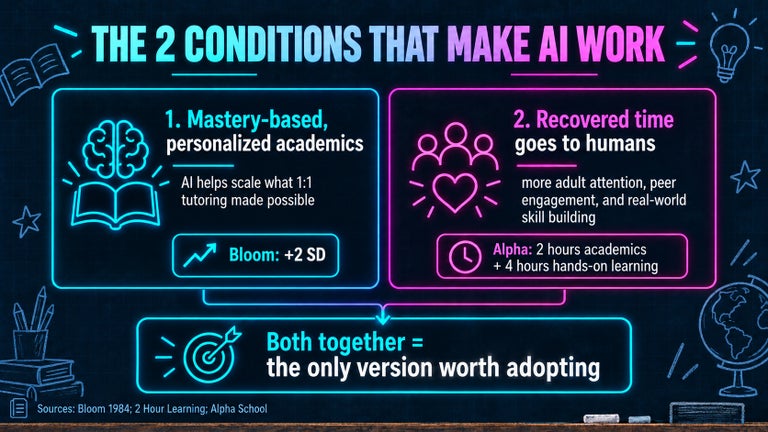
Neither condition carries the load alone:
- Condition one without two = An Efficient Screen Farm or Lecture Hall
- Condition two without one = A Warm School Where Kids Are Still Behind
- Both together = The Only Version Worth Adopting
Here’s where the almost from earlier earns its place.
Those two conditions are exactly what 2 Hour Learning, and schools like Alpha, are built around. And the results are difficult to ignore.
At Alpha, core academics are completed in two hours or less per day. Four hours are dedicated to hands-on learning, peer-to-peer engagement, and skill building. Performance has now reached beyond the 99th percentile - we’re talking comparable to the top 0.1% of schools globally.
These are the stakes we’re playing for.
Make AI Earn Its Place in the Classroom
The default answer to AI should be no. That answer can change, but only when the AI clears a meaningful bar.
When the next tool arrives with a demo and a pilot proposal, ask two things:
- Is this feeding the student’s thinking or standing in for it? Ask how the tool behaves when a student asks it for the answer. If the honest reply is that it delivers the answer faster, that’s a dud.
- And where does the recovered time go? If the tool works and frees up hours, name who those hours belong to before anyone signs. If the answer is more instruction on the same screen, the model hasn’t moved, and the tool won’t change anything.
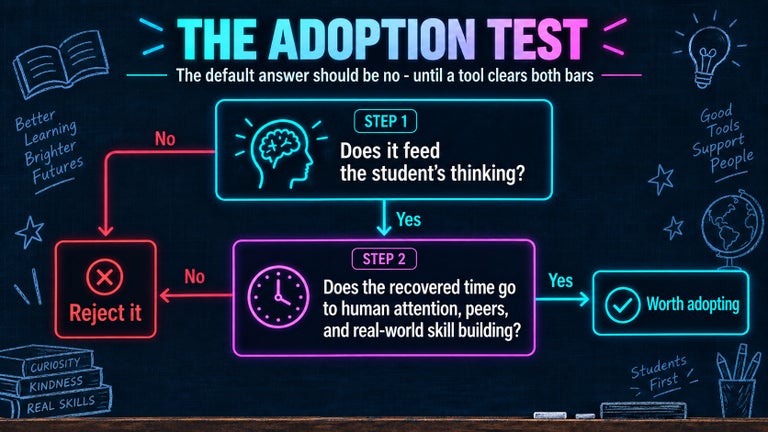
Most of what's on offer fails one of those. A fair number fail both.
A fresh coat of paint on a condemned building is still a condemned building. And the paint is being charged to your students in instructional time you will never get back.
Say no to hype-AI, but start shaping the ground for quality AI that makes a difference.
Want to teach inside a model that got rebuilt rather than repainted? Explore education roles through Crossover and work on the version that clears both bars.
Similar post


Want to read more?
We have a lot more where that came from

![Crossover’s Basic Fit Check [Official AI Screening Guide]](https://assets-us-01.kc-usercontent.com:443/7beb5311-75a4-0049-50f5-8f58fd55aba7/90bfc8de-1a38-4802-8432-c063c215e90a/BasciCheckGuide.jpg?fm=jpg&auto=format&w=500&h=500&fit=clip)





 AI-first education leaders.