Contents
- Learning Gaps Grow in a One-Pace Classroom
- AI Catches Students Up by Building From TheirLevel
- Students Level Up When They Move On Mastery
- Critical Thinking Needs Built Knowledge
- Choose AI That Helps Students Think
Every teacher knows the seventh-grader still struggling with fourth-grade work. Come year’s end, the class moves on, and that struggling student carries the gaps in their knowledge into the next grade. MOST of the AI that students use is fully capable of making homework faster without supporting the knowledge and understanding that should sit behind it. The tools that actually help start with what the student knows and work from there. Here’s how to spot AI that helps, and avoid AI that harms.
Your students are already using AI for schoolwork; whether it’s helping or harming is another question.
Scrutinising the adoption of AI in your students’ learning is a fair position to take. Work finished faster isn’t work mastered, and artificial intelligence is fully capable of turning a half-understood worksheet into a complete one, while leaving a student’s underlying knowledge exactly where it started.
Generative AI chatbots are offering a shortcut that’s poised to hit students already at risk.
On the 2024 Nation’s Report Card, 24% of US fourth-graders scored below Basic in math, and only 31% performed at or above proficient in reading. That’s a lot of kids moving deeper into their education unprepared for the lessons ahead.
Somewhere in your classroom there IS a kid whose work is resting on a foundation months or years below the lesson on the board.
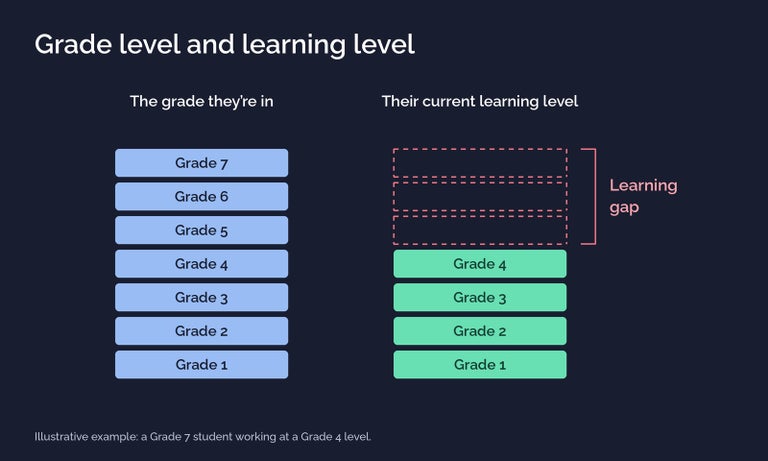
That student lives at two levels: the grade they’re in, and the level they’ve actually mastered. Only the second matters.
AI is the best chance we have for helping kids reach their limitless potential. But only one version of it will get us there.
Here’s how AI can help your students catch up, level up, and think critically.
Learning Gaps Grow in a One-Pace Classroom
A gap left behind doesn’t hold still. A student who never mastered fractions meets them again in every ratio, percentage, and equation that follows. Every unit built on top stretches that gap a little wider.
Traditional learning environments are a logistics nightmare. Supporting every individual kid in a class of thirty, while managing paperwork, classroom dynamics, planning, and delivery (just to name a few) is practically impossible at the best of times. Stretch that across a 36-week K12 school year, and it becomes the world’s least funny joke.
And when a subject sinks for a student - and one built on a shaky foundation always does - either ‘it just wasn’t the kid’s topic,’ or the teacher wasn’t good enough.
Kids are struggling, and they’re taking education into their own hands - leaning on AI as their saving grace. Problem is, most of the chatbots they turn to never touch the structures at the root of the student learning issue.
According to Pew Research Center, one in ten US teens say chatbots help with all or most of their schoolwork. And in a randomized trial of 275 students published in Computers and Education: AI, those with AI support finished tasks more successfully, while their grasp of the concepts was left no deeper than before.
Chatbots are aimed at tasks. → Kids feel that a great grade means a job well done. → Learning doesn’t give a damn about a finished worksheet.
Now, I don’t want to give the wrong impression here. AI in education IS making learning more fair and effective for students. But, and it’s a big but, that only includes AI that’s actually built for learning.
Help aimed at tasks will leave your student’s gaps compounding. Here’s how real educational AI can actually help close them.
AI Catches Students Up by Building From Their Level
Catching up starts at the last point where a student’s understanding still holds.
Here’s a real case study from 2 Hour Learning.
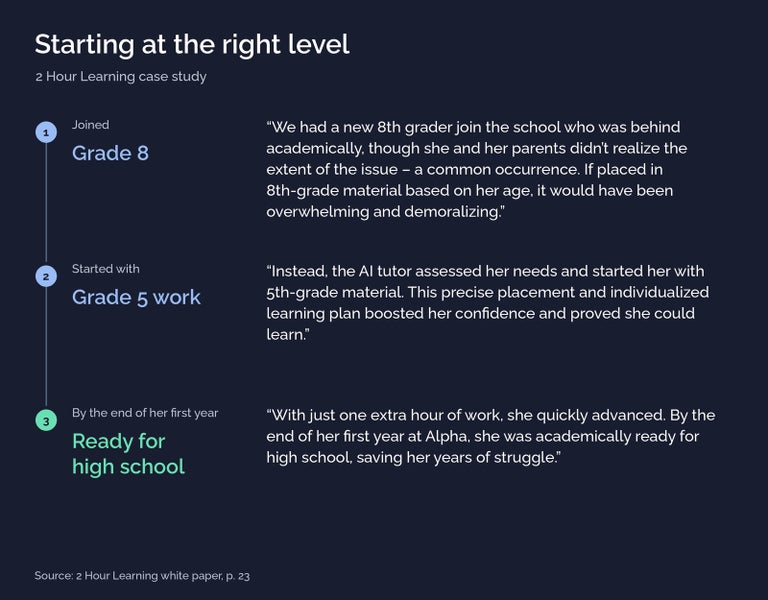
What looked like a step backwards was the fastest route forwards…
But bringing her back to her last solid level only got her to the starting line. The personalized learning process that happened from that point on is what allowed her to build back up more solid than before.
Chung, Zhang, Kung, Bastani and Bastani tested this personalized building in a five-month Python course across ten Taipei high schools. One group worked through a fixed easy-to-hard sequence (the standard flavour of traditional education), and the other got AI that chose each student’s next problem from their own work (personalized progression). On an unassisted final exam, the adaptive group outscored the fixed-sequence group by 0.15 standard deviations, which some estimates put at 6-9 months of schooling.
And the gain survived the tool being taken away, in an exam students sat alone. That’s the test catching up has to pass: the gain holds once the help is gone.

In his April Dispatch, Carl Hendrick, PhD educator and senior learning scientist at Alpha School, put the test in one question:
“Is this system adapting to what my students are thinking, or merely to whether they are getting things right?”
That’s the question to ask. When a student gets a problem wrong, does the next problem respond to why they got it wrong, or does it swap in an easier one and move on?
A tool that only marks right and wrong can place a student and still lose them. It knows she missed, but has no idea what she was thinking when she did.
Placement starts the climb. How and when she moves on decides whether it holds.
Students Level Up When They Move On Mastery
A student levels up when what they learned is secure, and not a day before.
So a tool has to tell secure work from shaky work. The 2 Hour Learning white paper draws the line with scores: a student consistently above 95% is on material that’s too easy, and one below 70% is on material that’s too hard. The work that builds a student happens between those two lines.
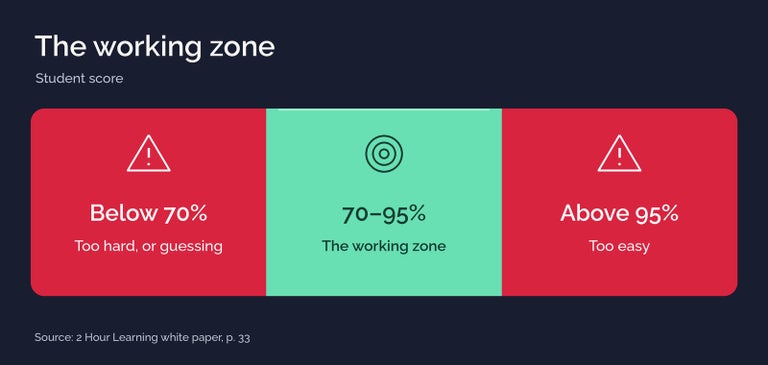
Alpha’s AI-powered system holds students inside that band. Carl describes their AI tutoring system like this:
“It calibrates the difficulty in real time, refuses to let a student move on until the current idea is genuinely secure, and tells the human guides precisely which child needs what.”
Holding a student back until the idea is secure sounds like pulling a handbrake. But the reality is very different.
Alpha reports that at its campus in Brownsville, Texas, in one of the poorest school districts in the country, students learned 2.1x faster than peers going through more traditional programs.

The beauty of mastery-based learning is that it doesn’t quit when a student has caught up. Here’s what Sam DePalo, Lead Guide at Alpha Fort Worth, describes:
“If a student comes in at fourth grade but is at a first-grade reading level, they can accelerate rapidly while still filling every hole in their learning. They master first grade, move to second, master second, move to third, and keep going until they reach their grade level and can move beyond it.”
The real level can start below the grade and finish above it. Mastery carries a student through, and the grade stops being the ceiling.
Ask yourself, what’s moving your students on: the date, the finished worksheet, or mastery they’ve shown? It’s the exact same question you should be asking of the AI tools you’re using.
Critical Thinking Needs Built Knowledge
Time for the final step.
Thinking critically needs something to think with: knowledge a student has already built.
As Carl puts it:
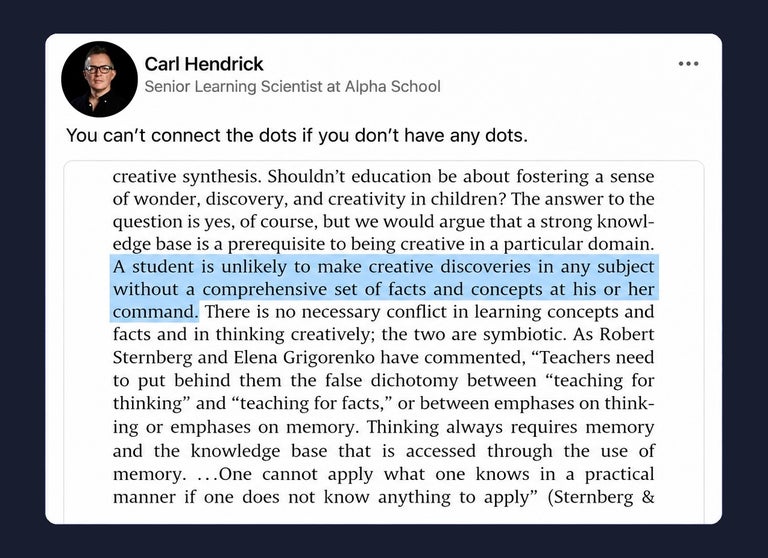
The dots are knowledge, and a student builds them one mastered step at a time.
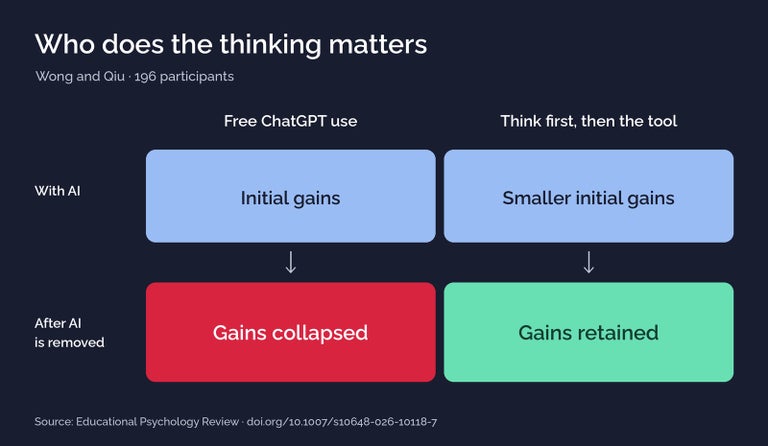
Hand the connecting to a chatbot and the dots never get built. Wong and Qiu tested this in a 196-participant study on learning gains in independent human creativity.
Participants were split into two groups - one with unrestricted AI usage through ChatGPT, and one that was forced to think up front. The group with free use saw gains in creativity scores at first, but those gains collapsed once the AI was taken away. The thinking group who brought the tool in afterwards gained less on the frontend, but kept what it gained when AI was removed - outperforming both the free ChatGPT group and the baseline on creativity.
Same tool. But the impact of AI changed depending on who did the thinking.
Alpha flat-out bans chatbots on Alpha campuses, labelling them cheatbots. Instead, opting for purpose-built AI tutors designed to support thinking and never offload it from the student. As Carl puts it:
“What it never does is the one thing an open chatbot does by default, which is the actual thinking. The aim is that the cognitive work stays exactly with the student.”
AI that does the thinking removes the dots before the student builds them. How and where a student can think critically starts where their knowledge does: at their mastered level.
Choose AI That Helps Students Think
Go back to the student sitting in a seventh-grade lesson on a fourth-grade foundation. Seen from here, that’s a placement problem. Their real level is fourth grade, and every piece of help that starts in seventh sails over their head.
The same goes for thinking. A student reasons from what they know, not what their grade says they should know.
Help that builds from their real level builds the thinker too.
Four questions sort the tools that do that from the tools that only make the work look finished:
- Does it adapt to what my student is thinking, or only to whether they’re right?
- Who does the thinking, the student or the tool?
- Did the gain hold on an unassisted test, with the tool removed?
- Does a student move on by showing mastery, or by finishing the work?
Ask them, and you can tell which tools take on the thirty levels the system hands you, and which leave them on your desk. That’s how you find help that can start building your students from where they actually stand.
So how can AI help students? By finding the level each one stands on, holding them there until it’s secure, and leaving the thinking with them.
Similar post


Want to read more?
We have a lot more where that came from

![Crossover’s Basic Fit Check [Official AI Screening Guide]](https://assets-us-01.kc-usercontent.com:443/7beb5311-75a4-0049-50f5-8f58fd55aba7/90bfc8de-1a38-4802-8432-c063c215e90a/BasciCheckGuide.jpg?fm=jpg&auto=format&w=500&h=500&fit=clip)




 AI-first education leaders.